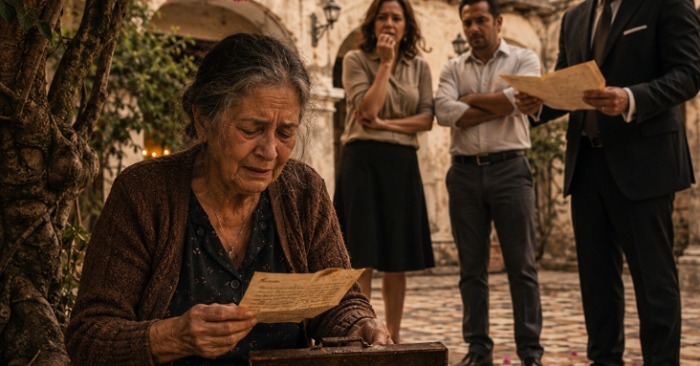
Elvira read the first sentence three times.
My beloved Elvira, forgive me for letting you believe I never knew how to love you.
Her hands began to shake.
For forty-eight years, Anselmo had been a man of actions and almost no words.
He repaired broken hinges before she noticed them.
He warmed water when her joints hurt.
He left half his dinner untouched whenever food was scarce so she could eat more.
But he had never written her a love letter.
At least, that was what she had believed.
Now thirty-eight sealed envelopes rested inside the iron box.
One for each year since the bougainvilleas had first been planted.
Elvira sat on the damp earth.
The wooden spoon lay beside her.
She opened the second envelope.
It was dated the year Lorena was born.
Today you held our daughter and told me you were afraid you would not be a good mother. I wanted to tell you that I had never seen anyone love so fiercely. Instead, I said the baby needed another blanket. I have always failed at saying the right thing.
Elvira covered her mouth.
She remembered that day.
She had believed Anselmo was uninterested.
He had stood near the window, silent, while she cried from exhaustion.
She never knew he had gone into the workshop that night and written those words.
The third letter was dated after her first illness.
You slept for fourteen hours. I sat beside you counting every breath. When you woke, I told you the chickens needed feeding. The truth was that I had spent the night begging God not to take you.
Tears blurred the page.
One after another, the letters transformed ordinary memories.
His silences had not always been indifference.
Sometimes they had been fear.
Sometimes shame.
Sometimes a love so deeply buried that he had not known how to carry it openly.
But beneath the letters lay something else.
A deed.
Elvira unfolded it carefully.
The property was not registered to Anselmo.
Nor to her.
It was held by a private trust created thirty-eight years earlier.
The beneficiary was listed as:
Elvira Cárdenas, sole lifetime occupant and controlling trustee.
She read the words slowly.
The mansion could not legally be sold without her independent authorization and confirmation from a second trustee.
The signature on the sale contract suddenly meant nothing.
Someone else had approved the transaction.
Someone who had no right to.
Footsteps sounded behind her.
“Elvira?”
Lorena stood beneath the corridor arch.
She looked exhausted.
Fabián stood beside her.
His expression changed when he saw the iron box.
“What is that?” he asked.
Elvira folded the deed against her chest.
“Something your father buried.”
Fabián stepped closer.
“You should not be digging alone.”
She looked directly at him.
“Did you know the house was protected by a trust?”
His face remained still.
Too still.
Lorena turned toward him.
“What trust?”
He laughed.
“Her husband probably created some old family document that no longer matters.”
Elvira rose slowly.
Her knees ached, but her voice did not weaken.
“It matters enough that your name appears as the second trustee.”
Lorena stared at her husband.
“What?”
Fabián’s confidence disappeared.
Elvira opened the deed.
Years earlier, Anselmo had appointed Don Eusebio as secondary trustee.
After Eusebio retired, the role was transferred temporarily to Fabián because he was a licensed financial adviser and part of the family.
Elvira had never known.
Anselmo trusted him to protect the house if anything happened.
Instead, Fabián had used the position to approve the sale.
“You signed this,” Elvira said.
Lorena looked at him.
“You told me Mom had full authority.”
“She did.”
“No,” Elvira replied. “Not without your confirmation.”
Fabián’s jaw tightened.
“The property was drowning in debt.”
“Whose debt?”
Silence.
Elvira understood before he answered.
The mansion itself had no major mortgage.
The unpaid taxes were manageable.
The crushing financial crisis Fabián described came from loans secured against the property without Elvira’s knowledge.
Loans connected to his failing development company.
Lorena stepped back.
“You borrowed against my mother’s house?”
“I was going to repay it after the hotel project.”
“You told me we were helping her.”
“We were.”
“You were helping yourself.”
Fabián turned toward Elvira.
“The sale solves everything. You receive enough money to live comfortably, the debts disappear, and the investor restores the property.”
“You mean the investor pays your loans.”
His voice hardened.
“You do not understand business.”
“No.”
She looked down at Anselmo’s letters.
“But I understand theft.”
A car entered the courtyard.
Mauro Salgado, the real estate agent, stepped out first.
Behind him came Jimena Alcázar, the investor.
Both stopped when they saw the open ground beneath the bougainvillea.
Mauro forced a smile.
“Mrs. Elvira, digging around the roots can damage the landscaping.”
She held up the deed.
His smile vanished.
Jimena looked toward Fabián.
“What is that?”
“An obsolete trust document,” he replied quickly.
Elvira handed it to her.
Jimena read the first page.
Then the second.
Her expression became cold.
“This sale was presented to me as clean.”
“It is clean.”
“No.”
She pointed toward the trustee clause.
“The consent was invalid.”
Mauro began gathering the scattered papers.
“We can resolve this privately.”
Elvira stepped between him and the box.
“Do not touch my husband’s letters.”
He stopped.
Jimena looked at Fabián.
“Did you disclose your personal debts against this property?”
He said nothing.
That was answer enough.
She immediately called her attorney.
Within an hour, the mansion’s handover was suspended.
By afternoon, Don Eusebio arrived.
He walked slowly with a cane, but anger sharpened his voice.
“I warned you.”
Elvira looked down.
“I thought Anselmo was afraid of change.”
“He was afraid of exactly this.”
Eusebio explained the trust.
Thirty-eight years earlier, after Anselmo nearly lost the mansion because of a dishonest business partner, he created a legal structure to guarantee Elvira would always have a home.
He never told her because he feared she would see it as another form of control.
Instead, he buried copies beneath the bougainvillea and left instructions in case the official records were altered.
“Why the third tree?” Elvira asked.
Eusebio smiled sadly.
“Because that was the one you planted together after your first miscarriage.”
Elvira closed her eyes.
She had almost forgotten.
The third bougainvillea had been planted during the darkest year of their marriage.
The house had felt empty.
They had spoken very little.
Anselmo spent hours caring for that plant.
She believed he preferred the garden to her grief.
One of the final letters explained the truth.
You asked why I kneel beside this tree so long. I could not tell you that every new flower feels like proof that something can survive after loss. I cared for its roots because I did not know how to care for your sorrow.
Elvira wept openly.
Lorena sat beside her.
For the first time since Anselmo’s death, mother and daughter held each other without Fabián standing between them.
“I’m sorry,” Lorena whispered.
“For what?”
“For pushing you.”
“You were worried.”
“I let him decide what worry should look like.”
Elvira looked toward Fabián.
He stood near the corridor speaking urgently into his phone.
The investigation uncovered more within days.
Fabián had created false maintenance invoices.
He exaggerated the mansion’s debts.
He pressured the appraiser to lower the property value while secretly negotiating a profit-sharing agreement with Mauro.
The boutique hotel deal would have paid him enough to save his company.
Jimena had not known the full plan.
When she learned the truth, she withdrew from the purchase and cooperated with authorities.
Mauro lost his license.
Fabián faced charges for fraud, breach of trust, and document falsification.
Lorena filed for separation.
It was not immediate.
She spent nights crying.
She had loved him.
She had built a life with him.
But she could not ignore that he had used her mother’s grief as a business opportunity.
Elvira did not celebrate his downfall.
She was too tired for revenge.
She wanted only the house returned to her name and the debts removed.
The court voided the sale.
The fraudulent loans were assigned to Fabián’s company.
The mansion remained hers.
But keeping it created another problem.
The roof still leaked.
The well remained blocked.
Eleven rooms were too many for one elderly woman.
Anselmo’s warning had told her not to sell.
It had not told her she must live alone.
That distinction mattered.
Elvira gathered Lorena, Eusebio, and several neighbors in the courtyard.
“I will keep the house,” she said.
Lorena smiled with relief.
“But I will not preserve it as a tomb.”
Over the following year, the mansion changed.
Three rooms became affordable housing for elderly women who had nowhere safe to live.
The old workshop became a community kitchen where Lorena taught baking classes.
The rear rooms became a small craft school for local children.
Jimena returned with a different proposal.
Not to buy the property.
To fund restoration through a heritage grant without taking ownership.
Elvira accepted only after independent attorneys reviewed every page.
The third bougainvillea remained untouched.
Beneath it, they placed a new iron box.
Inside were copies of Anselmo’s letters.
Not the originals.
Those stayed in Elvira’s bedroom.
She read one each week.
Sometimes they made her laugh.
Sometimes they made her angry.
He had loved her deeply.
He had also made her spend decades guessing.
Love hidden completely could still wound the person it intended to protect.
One evening, Elvira sat beneath the bougainvillea while Lorena poured coffee.
“Do you forgive him?” her daughter asked.
Elvira looked toward the blossoms.
“For loving me?”
“For never telling you.”
She considered the question.
“Some days.”
Lorena smiled.
“That sounds honest.”
“It is more than your father managed.”
They both laughed.
On the first anniversary of Anselmo’s death, the mansion opened its courtyard to the neighborhood.
Children ran beneath the corridors.
Elderly residents sat in the shade.
Music played near the restored well.
Elvira placed Anselmo’s final letter on the table.
It had been sealed separately beneath the deed.
She had waited a year to open it.
Elvira, if you are reading this, I am no longer there to repair what breaks. I know you may sell the house because I left you too many bills and too few explanations. I am sorry. The house itself is not what can save you. What can save you is the life hidden inside it—the people, memories, work, and love that can still grow if you choose not to close the doors. Do not protect the walls. Protect what happens within them.
Elvira pressed the paper against her heart.
At last, she understood.
Anselmo had not asked her to remain imprisoned in the past.
He wanted her to recognize the value of what they had built before someone else turned it into profit.
The mansion survived.
But not as it had been.
Its worn mosaics remained.
The bougainvilleas continued climbing.
The old wooden corridors filled with new voices.
And Elvira discovered that the deepest love buried beneath the third tree was not merely Anselmo’s devotion to her.
It was his belief that after forty-eight years of silence, loss, and unfinished sentences, her life still deserved to bloom.