Álvaro stared at the envelope, unable to bring himself to touch it.
He recognized Inés’s handwriting.
The slightly slanted letters. The way she extended the final stroke of her name.
“How did you get this?”
Lucía remained beside Bruno.
“Your wife gave it to me three weeks before she died.”
She explained that before working in this house, she had been a music educator for children with special needs.
She had met Inés at a hospital several months before her illness became incurable. Inés was looking for someone capable of understanding Bruno without constantly trying to make him “normal.”
“Why hire you as a housekeeper?” Álvaro asked.
“Because Inés knew you would turn my presence into another therapeutic program. With goals, reports, and weekly results.”
The sentence hurt because it was true.
Inés had quietly arranged for Lucía to be hired. She wanted Lucía to observe Bruno in his everyday life, without a medical coat, without a stopwatch, and without making him feel as though he were constantly being evaluated.
“And why didn’t you tell me anything after she died?”
“I tried. But you wouldn’t even look at me when I answered you.”
Álvaro finally took the envelope.
Inside was a letter and a small memory card.
He inserted the card into the computer sitting beside the piano.
Inés appeared on the screen, thinner but smiling.
“Álvaro, if you’re watching this video, Bruno has probably started laughing again. Don’t try to figure out which method worked. Just ask yourself who gave him the time to be heard.”
Álvaro closed his eyes.
In the video, Inés explained that the three notes were not simply a melody. Bruno had already been playing them when he was very young. They meant that he wanted someone to stay close to him.
After his mother’s death, he had continued tapping that rhythm on tables.
No one had understood.
Except Lucía.
“How long have you known?” Álvaro asked.
“Almost two years.”
“Why did he only laugh today?”
“Because today, he decided he was ready.”
The next day, Álvaro gathered the therapists who had been working with Bruno.
He did not dismiss them.
But he asked them why none of their reports mentioned the three taps on the table, the sound of the elevator, or the melody.
The program director spoke about clinical goals and protocols.
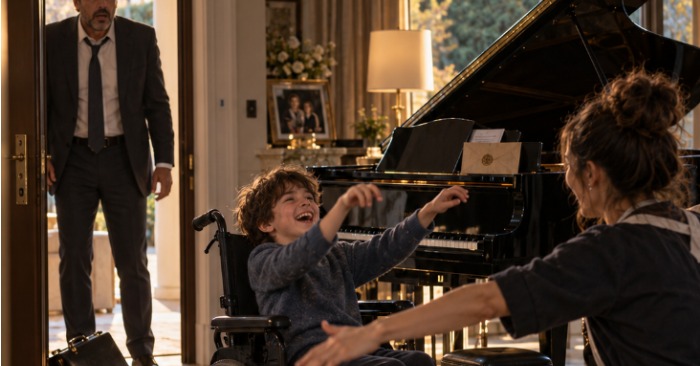
Bruno then tapped three times on the wooden piano.
Lucía answered with three notes.
The boy smiled.
Everyone fell silent.
Álvaro finally understood that his son had never stopped communicating. The adults had simply decided in advance what form his voice was supposed to take.
He offered Lucía the opportunity to run a private program for Bruno.
She refused.
“I’ll stay if Bruno wants me to. But I don’t want to become another person who makes decisions for him.”
Álvaro stood in front of his son.
He resisted the urge to ask ten questions.
Then he gently tapped three times on the piano.
Bruno looked up at him.
Álvaro waited.
For a long time.
Finally, Bruno placed his hand over his father’s.
“Stay.”
That one word did not repair the twenty-three months of distance.
It did not bring Inés back.
But that evening, Álvaro canceled his meetings, sat on the floor beside the armchair, and learned the only three notes that had managed to bring his son back to him.