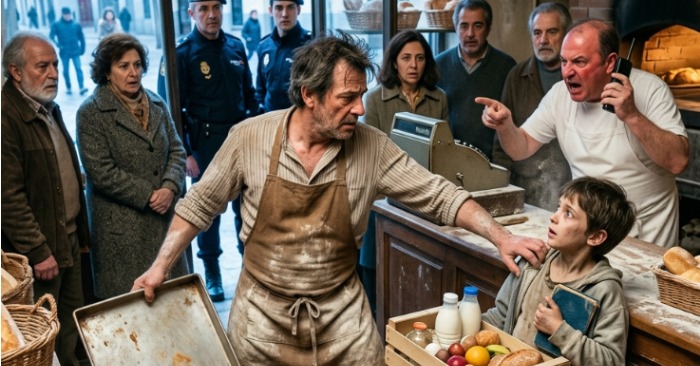
Don Julián slowly pulled the document from the notebook pocket.
When he saw the signature, his legs seemed to give way.
“That’s Isabel’s…”
Isabel had been his wife, who had died nine years earlier.
Ramiro immediately tried to take the paper back.
“This document has no legal value.”
I placed my hand over it before he could.
“My lawyer thinks otherwise.”
The deed proved that Isabel had financed a large part of the building’s purchase with her personal inheritance. In return, she had received forty percent of the shares.
After her death, those shares should have gone to Don Julián.
But Ramiro had hidden the original deed and had his brother-in-law sign a fake rental agreement. For nine years, Don Julián had therefore been paying rent to work in a building that partly belonged to him.
“Where did you find this?” he asked.
“My mother kept it.”
Twenty-five years earlier, Elena had cleaned the offices above the bakery. On the night we left, Isabel had entrusted her with an envelope and asked her to keep it somewhere safe.
She already suspected that Ramiro was altering the accounts.
My mother had wanted to return the envelope, but our departure had been rushed. A few months later, Isabel fell ill. The letters sent to the bakery were returned to us.
The envelope remained in a box for years.
I only discovered it after my mother’s death.
Inside were the deed, accounting statements, and a letter from Isabel addressed to her husband.
Don Julián carefully opened the letter.
“Julián, if you are reading this, it means I was unable to protect you myself. Never let Ramiro convince you that your kindness is a weakness. It is the one thing he could never buy.”
The old baker pressed the letter against his heart.
Ramiro backed toward the exit.
One of the police officers blocked his way.
My lawyer had just arrived with two investigators. The statements showed that Ramiro had collected rent he was not entitled to and transferred part of the bakery’s revenue to a company he owned.
“This is a family matter,” he protested.
Don Julián finally looked up.
“No. A family does not steal nine years of work from the man who trusted them.”
The police took Ramiro away for questioning.
Silence fell over the shop once again.
Don Julián looked at the purchase agreement.
“You bought the entire building for me?”
“No.”
His expression faltered.
I turned the agreement toward him.
The new owner was a foundation created by my mother and me. Its mission was to provide meals and vocational training to young people in difficult circumstances.
Don Julián would become its honorary director and retain his share of the building.
“I’m too old to start over, Samuel.”
“Then don’t start over alone.”
I opened the blue notebook.
The pages contained the names of people I had helped over the years: students, evicted families, children placed in foster care, workers without homes.
Several of them were waiting outside.
A cook.
An accountant.
Two apprentice bakers.
A woman whom Don Julián had fed when she was raising her three children alone.
They had all come to help him.
The bakery did not regain its former glory immediately. The oven had to be repaired, the debts had to be paid, and the storefront window had to be replaced.
Don Julián never became the tireless man I had known in my childhood again.
But every morning, he sat beside the counter, teaching the young people how to recognize when dough was ready to go into the oven.
The blue notebook remained on display inside a small glass case.
On the final page, Don Julián added a new sentence:
“Kindness may not pay every bill. But sometimes, twenty-five years later, it comes back to save the home.”