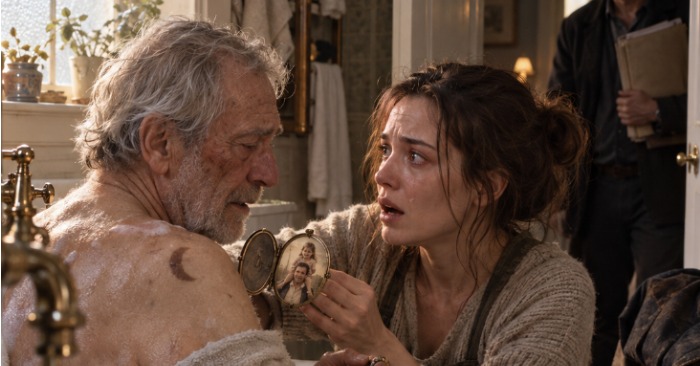
Henri slowly unclenched his fingers.
Resting in his palm was a bracelet made of yellow and blue threads, finished with a white bead.
I had made it when I was twelve.
I had insisted that he wear it even at work. My father used to say that the colors made him look like a king.
“Where did you find it?” I asked.
Henri frowned.
“It was with me when I woke up. I didn’t know who it belonged to. I only knew that I couldn’t throw it away.”
I left the bathroom to give him time to get dressed. In the hallway, Marc handed me his file.
He had recognized the name of the construction site Henri had mentioned at the shelter. Marc’s company had acquired the records of an old construction firm. Among the documents was a report, from twenty years earlier, about a worker who had disappeared after a scaffolding collapse.
My father.
“Why didn’t you tell me before bringing him here?” I asked.
“I wasn’t sure. He couldn’t remember his own name. I didn’t want to make you relive that loss over a simple resemblance.”
“Then you should have told me what you suspected.”
Marc lowered his eyes.
“Yes. I’m sorry.”
The records told a different story from the one I had been given. My father hadn’t left his job willingly. Injured in the accident, he had been taken under an incomplete identity to a distant hospital. His employer had never connected that patient to the missing worker.
Henri came back, clean and dressed in clothes Marc had lent him. He looked at me cautiously, as though he were afraid of disappointing me.
I showed him more photographs.
He didn’t recognize the house.
He didn’t remember my sixteenth birthday.
But when he saw a picture of the two of us in the kitchen, he suddenly said:
“You refused to let me cut your toast. You always wanted to do it yourself.”
I burst into tears.
A test carried out over the following weeks confirmed what the bracelet, the mark, and that memory had made us hope for: Henri was my father.
We didn’t recover twenty years in a single evening.
Some days, he remembered a song he used to sing to me when I was little. On others, he couldn’t even remember the construction site. He needed care, rest, and the freedom to decide where he wanted to live.
One morning, sitting by the window, he called me by my first name for the first time.
“Élise. I didn’t know how to come home.”
I sat down beside him.
For twenty years, I had believed he had chosen to leave. He had spent those same years without knowing what he was searching for.
I took his hand.
“You’re here now.”
He looked at the bracelet around his wrist, then at my pendant.
Without knowing it, we had each kept the proof that the other had existed.