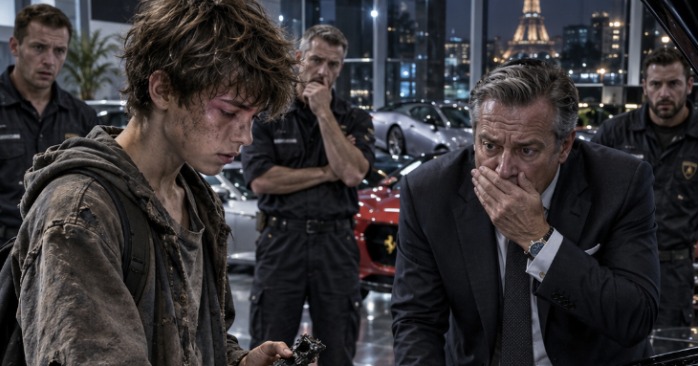
Armand could no longer take his eyes off the metal plate.
“What was your father’s name?”
The boy hesitated.
“Malik Ben Salem.”
The silence was immediate.
The head mechanic looked at Armand.
“You knew him?”
Armand didn’t answer right away.
Then he slowly placed a hand on the edge of the hood.
“Yes.”
The boy frowned.
“How?”
Armand looked around, as though he had suddenly forgotten that all his employees were there.
“Because this car… he was the one who prepared it.”
The boy stood motionless.
“My father worked here?”
“Fifteen years ago.”
Armand turned toward him.
“He was the best mechanic I ever had.”
The boy lowered his eyes toward the burned component in his hand.
“He never told me about it.”
Armand gave a bitter smile.
“He had his reasons.”
The head mechanic stepped closer.
“Why is his name engraved here?”
Armand ran a hand over his face.
“Because this car was supposed to become our joint project.”
The boy suddenly looked up.
“Your project?”
Armand nodded.
Back then, he explained, the dealership was nothing more than a small garage.
Malik could fix anything.
Engines that everyone else declared dead.
Problems no one else could locate.
Armand, on the other hand, knew how to sell.
Together, they had started making a lot of money.
Then everything changed.
“One night,” Armand continued, “we had an argument.”
The boy didn’t move.
“Why?”
Armand hesitated.
“Because I made a decision without him.”
“What decision?”
He looked at the car.
“I sold a prototype he had designed.”
The boy’s expression hardened.
“Without his permission?”
Armand lowered his eyes.
“Yes.”
The silence grew heavy.
“He left the next day.”
The boy clenched his jaw.
“And you let him leave?”
“Yes.”
“You tried to find him?”
That question seemed to hurt more than all the others.
“Not hard enough.”
The boy looked away.
“He died three years ago.”
Armand closed his eyes.
“How?”
“An illness.”
Then the boy added:
“By the end, he couldn’t work anymore.”
Armand remained silent.
“And you?” he finally asked. “Where is your family?”
The boy let out a small, humorless laugh.
“There’s not really anyone left.”
His mother had died several years earlier.
After his father’s death, he had stayed with an uncle for a while.
Then the arguments began.
He left.
For the past few months, he had sometimes slept in a shelter, sometimes at a train station.
The head mechanic looked at his colleagues.
No one dared joke anymore.
Armand pointed to the small part the boy had found.
“How did you know?”
The boy looked at the engine.
“My father taught me how to listen.”
“Listen to what?”
“To what the machine is trying to tell you.”
He pointed to the box.
“The engine wasn’t coughing like it had a fuel problem. It kept cutting out at exactly the same moment. So I thought about the relay.”
Armand gave a brief smile.
“Exactly like him.”
The boy tensed.
“Don’t say that just because you feel guilty.”
The words hit home.
Armand nodded.
“You’re right.”
Then he looked at his employees.
“Everyone out for five minutes.”
No one argued.
Once they were alone, Armand opened a secure drawer in his office.
He took out an old envelope.
“I’ve kept this for fifteen years.”
Inside was a photograph.
Two young men standing in front of an old garage.
One was Armand.
The other was Malik.
Behind them stood the same car, still unfinished.
The boy took the photograph.
His fingers trembled.
“That’s him.”
“Yes.”
Armand then pulled out a yellowed document.
“Your father was supposed to receive a share of the company.”
The boy looked up.
“Was supposed to?”
“The project was meant to belong to both of us.”
He swallowed with difficulty.
“But after our argument, nothing was ever signed.”
The boy put the paper down.
“Then why are you showing me this?”
Armand thought for a few seconds.
“Because everything I built afterward also began with his work.”
The boy shook his head.
“I don’t want your money.”
“I’m not offering you money.”
“Then what?”
Armand looked toward the workshop.
“A chance.”
The boy gave a suspicious laugh.
“Is this where you remind me of your joke about the dealership?”
Armand didn’t smile.
“It wasn’t funny.”
Then he continued:
“I’m not going to give you a company because you repaired a car.”
The boy nodded.
“Fair.”
“But I can offer you training, temporary housing, and a real salary.”
The boy remained silent.
“Why?”
Armand looked at the photograph of Malik.
“Because I should have done something fifteen years ago.”
The boy answered immediately:
“I’m not my father.”
Armand nodded.
“I know.”
“And I don’t want to become your way of forgiving yourself.”
This time, Armand remained silent for a long while.
Then he simply held out his hand.
“Then come only if you want to.”
The boy didn’t take his hand.
Not right away.
He looked at the photograph one more time.
Then at the car.
Then at the workshop behind the glass.
“Can I start tomorrow?”
Armand smiled faintly.
“You can start tomorrow.”
The boy put the photograph back into the envelope.
“I’m keeping this.”
“It’s yours.”
A few months later, the old car was still displayed in the center of the dealership.
But something had changed.
A small new plaque had been installed beneath its hood.
Not to tell a legend.
Not to turn Malik into a perfect hero.
Simply to acknowledge what had been forgotten.
And whenever the boy worked on a difficult engine, Armand would sometimes see him close his eyes for a few seconds.
Just like his father.
Not to guess.
To listen.
Because that day, it wasn’t only a car that a forgotten boy had managed to repair.
It was also a story that adults had left broken for fifteen years.