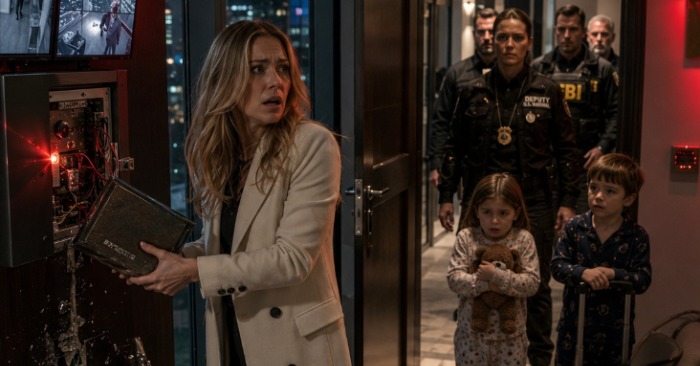
The automated warning repeated.
“Protected federal property alert.”
“Security protocol has been activated.”
Paige dropped the metal bookend.
It struck the hardwood floor with a heavy thud.
Hallie began crying.
Nolan grabbed his mother’s coat.
“Mom, what did you do?”
“Nothing,” Paige said quickly.
But her voice had changed.
She hurried toward the office doorway.
The penthouse lights dimmed.
Every interior door locked except the main living area and the emergency exit route.
Then the television turned on by itself.
So did the kitchen display.
The office monitor.
The wall panel beside the entrance.
Each screen showed the same image.
Paige standing outside the apartment twenty minutes earlier.
But she was not alone.
My parents were beside her.
My father wore a dark cap pulled low over his face.
My mother kept looking toward the elevator.
I sat upright in my London hotel room.
They had told me they were home in Richmond.
The hallway recording had started when Paige approached the door.
At first, the audio was faint.
Then my father’s voice became clear.
“Once you’re inside, check Marissa’s office first.”
Paige glanced toward the children.
“She said she sold the place.”
My mother laughed.
“She says things like that when she wants attention.”
My father handed Paige a folded sheet of paper.
“The blue storage drive should be inside the locked cabinet.”
Paige frowned.
“What is on it?”
“Financial records.”
“What kind?”
“The kind that belong to this family.”
My breath stopped.
Paige looked uncertain.
“I thought we were moving in.”
“You are,” my mother said.
“But first, find the drive.”
The recording paused.
Then the screen displayed a second angle.
My father leaning closer to Paige.
“Marissa has been hiding money.”
“If we get proof before she transfers it overseas, we can force her to divide everything fairly.”
Paige’s face on the live camera became pale.
She stared at the screen as though she had never heard the conversation before.
Perhaps she had not understood what it meant at the time.
Or perhaps she had only heard what she wanted to hear.
A new voice came through the penthouse speakers.
Calm.
Male.
Controlled.
“Ms. Keane, step away from the secured office.”
Paige spun around.
“Who said that?”
A man appeared on the largest screen.
Reid Langford.
The new owner.
He wore a plain dark shirt and stood inside what looked like a federal operations center.
“My name is Reid Langford.”
“This residence belongs to me.”
Paige lifted her chin.
“My sister gave me the code.”
“No.”
“She provided a one-time contractor-access credential and explicitly warned you that it did not grant residency or permission to enter restricted areas.”
Paige looked toward the children.
“This is a misunderstanding.”
Reid’s expression did not change.
“You struck a secured federal equipment cabinet after receiving an access warning.”
“I didn’t know it was federal.”
“The system announced it before the second impact.”
Paige said nothing.
I checked the camera history.
She had hit the panel twice.
The first strike triggered a yellow warning.
The second activated the full alarm.
Reid continued.
“Remain in the living room.”
“Do not touch any devices.”
“Officers are on their way.”
Paige’s confidence collapsed.
“You called the police?”
“The system contacted the appropriate authorities automatically.”
She grabbed her phone and called me.
I answered.
Her voice exploded through the room.
“What have you done?”
I stared at her through the live feed.
“I sold my apartment.”
“You set me up.”
“I warned you not to enter.”
“You gave me the code.”
“A temporary service code.”
“You knew I would use it.”
“I hoped you would read the warning.”
She paced across the living room.
“The children are here.”
“I can see them.”
“Then stop this.”
“I cannot cancel a federal security response from London.”
“You always do this.”
“Do what?”
“Make me look irresponsible.”
I almost laughed.
No one had ever needed to make Paige look irresponsible.
She managed that without help.
“Take the children to the sofa,” I said.
“Keep them calm.”
“Do not touch anything else.”
Then I looked at my parents on the paused hallway recording.
“Why were Mom and Dad searching for a blue drive?”
Silence.
Paige looked toward the screen.
“They thought you were hiding family money.”
“There is no family money.”
“Dad said—”
“Dad says whatever makes someone else solve his problems.”
She lowered her voice.
“They told me the penthouse was supposed to become mine.”
There it was.
Not an emergency.
Not temporary shelter.
A promise.
My parents had offered Paige property they did not own.
Again.
When Paige’s marriage ended two years earlier, I paid six months of rent for her.
My mother told her I would eventually buy her a house.
I never said that.
When my father’s business failed, I covered his tax debt.
He later told relatives I had agreed to make him a partner in my consulting firm.
I had not.
Every act of help became evidence, in their minds, that more was owed.
The elevator doors opened outside the penthouse.
Four officers entered the hallway.
Reid arrived behind them.
He must have been nearby despite appearing remotely moments earlier.
He approached the door calmly.
The system unlocked it for him.
Paige stood near the living room windows, holding Hallie against her side.
Nolan sat silently on a suitcase.
One officer spoke gently to the children.
Another asked Paige to place her phone on the table.
She complied.
Reid walked toward the damaged office panel.
He inspected it without entering.
Then turned to Paige.
“Did anyone instruct you to locate an item inside this room?”
Her eyes moved toward the screens.
“No.”
The hallway recording resumed automatically.
My father’s voice filled the penthouse.
“Find the blue drive before Marissa comes back.”
Paige closed her eyes.
Reid looked at her.
“I’ll ask again.”
She began to cry.
Not loudly.
Not dramatically.
For once, she looked genuinely frightened.
“My parents said Marissa was hiding financial records.”
“Did they tell you what records?”
“No.”
“Did they give you any tools?”
Paige hesitated.
Then pointed toward a storage bin.
An officer opened it.
Inside were clothes.
Children’s toys.
A pry bar.
Two screwdrivers.
A portable hard-drive duplicator.
And a printed photograph of my former office.
I felt cold.
This had never been only about forcing their way into my home.
Someone had prepared Paige to copy data.
Reid’s expression sharpened.
“Where did you get the duplicator?”
“My father.”
“Did he explain how to use it?”
“He sent me a video.”
One officer retrieved the folded paper my father had given her.
It contained a hand-drawn floor plan.
The secured cabinet was circled.
Beside it were four words:
BLUE DRIVE. TAKE EVERYTHING.
Reid looked toward the camera.
“Marissa, do you know what they believed was stored there?”
I did.
But I had not understood until that moment why my father wanted it.
Six months earlier, while helping him resolve another financial crisis, I discovered irregular transfers from a family trust created by my late grandmother.
The trust was intended to fund education and medical expenses for her grandchildren.
My father had served as temporary administrator.
For years, he told us the account had been exhausted.
It had not.
More than eight hundred thousand dollars had been moved through companies linked to him.
I copied the records.
Then I hired an attorney.
The blue drive contained my backup evidence.
At least, it had before the sale.
I had removed every personal file weeks earlier.
Reid’s cabinet contained only secured government equipment.
My father did not know that.
Neither did Paige.
“I believe my father was searching for evidence connected to a trust investigation,” I said.
Reid nodded once.
“Have you reported the suspected misuse?”
“My attorney has.”
“Which agency?”
I gave him the name of the financial-crimes investigator handling the matter.
One of the officers stepped into the hallway and made a call.
Paige stared at me through the screen.
“You reported Dad?”
“I reported missing money.”
“He is our father.”
“And Grandmother created that trust for all of us.”
Paige shook her head.
“You always think you are better than everyone.”
“No.”
“I finally stopped assuming being family made people harmless.”
The officers did not arrest Paige that night.
Her children were exhausted and frightened.
She cooperated after the evidence was found.
A family-services officer contacted her former husband, who arrived to collect Nolan and Hallie.
Before leaving, Nolan looked toward the camera.
“Aunt Marissa?”
My throat tightened.
“Yes?”
“Are you mad at us?”
“No, sweetheart.”
“None of this is your fault.”
He nodded.
Then took his father’s hand.
Paige watched them leave.
That was the first moment she truly understood what her choices had cost.
Not the penthouse.
Not the embarrassment.
Her children had watched her break into someone’s home because their grandparents promised her a life she had not earned.
Reid allowed her to sit in the living room while investigators documented everything.
Then he asked whether she would give a formal statement.
She agreed.
The next morning, federal investigators visited my parents.
My mother opened the door and claimed they knew nothing.
My father said Paige had acted alone.
Then investigators showed them the hallway recording.
They showed them the tools.
The floor plan.
The instructional video recovered from Paige’s phone.
My father’s expression changed.
My mother blamed him immediately.
“He said Marissa stole from us.”
My father blamed Paige.
“She misunderstood.”
Paige, for once, refused to carry their story.
She told investigators everything.
The trust case expanded quickly.
The missing money had funded failed property investments, private debts, luxury vacations, and repeated transfers into an account my parents controlled jointly.
Some payments had also gone to Paige.
She insisted she believed they were gifts.
Investigators confirmed she had not known their source.
Still, she was required to return what remained.
My father was charged with fraud, breach of fiduciary duty, falsifying records, and attempted destruction of evidence.
My mother avoided the most serious charges by cooperating.
She admitted she had encouraged Paige to enter the penthouse because she believed I was preparing to expose them.
Their marriage did not survive the investigation.
People in my family blamed me.
An uncle said I should have handled the matter privately.
A cousin accused me of choosing money over blood.
I asked one question.
“Would you say the same if the stolen money had belonged to your children?”
No one answered.
The trust recovered only part of what had been taken.
But enough remained to pay for Nolan and Hallie’s future education.
That mattered more to me than punishment.
Paige and I did not speak for eight months.
During that time, she moved into a small rented townhouse.
Found steady work at a dental office.
Entered counseling.
Stopped asking our parents to solve every crisis.
One evening, she sent me a message.
Not an apology.
A photograph.
Nolan sitting at a kitchen table doing homework.
Hallie drawing beside him.
The room was simple.
Crowded.
Clean.
Beneath the picture, Paige wrote:
This is our home now. I paid the deposit myself.
I stared at those words for a long time.
They were almost identical to what she had said inside my penthouse.
But this time, they meant something different.
Ownership.
Responsibility.
Truth.
I called her.
She answered but did not speak.
“I’m proud of you,” I said.
She began crying.
“I’m sorry.”
“For entering the apartment?”
“For believing that loving me meant you had to keep giving me things.”
I closed my eyes.
“I helped create that belief.”
“No.”
“Mom and Dad did.”
“And I chose to keep believing it because it was easier.”
That was the first honest conversation we had ever shared.
Rebuilding our relationship took time.
I no longer paid her bills.
She no longer asked.
I visited the children when work brought me back to Virginia.
Reid and I stayed in occasional contact because of the case.
The damage to his security panel was repaired.
He refused reimbursement after learning the recovered hallway footage had helped expose the trust fraud.
Months later, he told me something I never forgot.
“Security systems do not reveal character.”
“They only record what people do when they think no one can stop them.”
My parents thought distance made me powerless.
Paige thought a code meant permission.
All three believed family connection erased ownership, boundaries, and consequences.
They were wrong.
The night every screen lit up inside that penthouse, the most important recording was not the one showing a break-in.
It was the one capturing the lie beneath it.
My sister had not arrived because she needed shelter.
She arrived because our parents promised her my life.
And losing that illusion became the first step toward building one of her own.