Ruth did not ask whether I wanted to save my marriage.
She did not tell me to calm down.
She did not remind me that Trevor was the father of my child.
She simply poured tea into two chipped porcelain cups and waited for me to breathe normally again.
My son, Caleb, slept in a laundry basket lined with folded blankets beside the kitchen table.
I stared at him.
His tiny chest rose and fell as though nothing in his world had changed.
“I need an attorney,” I said.
Ruth nodded.
“I know one.”
Her former student, Elena Vasquez, had become a family-law attorney in Phoenix.
Ruth called her before seven that morning.
Elena agreed to meet us privately that afternoon.
Before leaving the Hayes estate, I had taken only one suitcase.
But months earlier, I had placed copies of everything important inside a secure online account Trevor did not know existed.
Bank statements.
Tax returns.
Corporate expense reports.
Property records.
Insurance policies.
Messages.
Audio recordings.
And photographs of documents Trevor repeatedly removed from the home office after I asked about them.
I had not begun collecting evidence because I wanted revenge.
At first, I simply wanted to know why our finances no longer made sense.
Trevor earned a generous salary as development director for Hayes Hospitality Group.
Still, our joint checking account was constantly low.
He claimed construction costs on our future house had increased.
But whenever I asked to visit the building site, he postponed the trip.
Then I found an invoice for imported marble.
The delivery address was not our future home.
It was his parents’ estate.
I assumed it was a bookkeeping mistake.
Then I found another.
Custom windows.
Italian cabinetry.
Pool renovations.
Every invoice was paid through an account bearing both my name and Trevor’s.
The money had come from a business investment fund I created before our marriage.
I had transferred part of it into a joint account after Trevor said it would help us qualify for better property financing.
He promised the funds would be used only for our home.
Instead, they were quietly paying for improvements to his parents’ estate.
When I confronted him, he kissed my forehead.
“You’re reading too much into ordinary family accounting.”
His mother was less gentle.
“Trevor understands wealth better than you do.”
That sentence would have been amusing had I not spent eight years auditing corporate accounts before marrying him.
I began looking more carefully.
One transfer led to another.
Money moved from our joint investment account into a Hayes family construction company.
From there, it passed through three related businesses.
Then it paid invoices attached to the estate.
The paperwork described the transfers as loans.
There were no repayment schedules.
No interest.
No board approvals.
Only signatures.
Some were mine.
Except I had never signed them.
When I showed Elena the first forged document, she stopped reading.
“Did you authorize this?”
“No.”
“Did you digitally sign anything around this date?”
“I was in the hospital giving birth.”
Her expression changed.
The document transferring nearly six hundred thousand dollars from our marital account had been signed two days after Caleb was born.
I had been recovering from an emergency procedure.
Heavily medicated.
Barely able to stand.
Trevor had brought papers into my hospital room.
He said they were insurance forms for the baby.
I remembered signing two pages.
Not twelve.
Elena looked through the rest of the file.
“This is not just a divorce case.”
“What is it?”
“Potential fraud.”
The word made the room feel smaller.
I had known Trevor was dishonest.
I had not allowed myself to name what he had done.
Elena asked me to explain the living arrangement.
The estate belonged, according to Trevor, to his parents.
But property records showed that the original house had been placed into a family trust six years earlier.
The trust owed more than the property was worth.
Then, eighteen months before Caleb’s birth, the debt disappeared.
A separate holding company purchased the mortgage.
That company was funded almost entirely through transfers from my premarital investment account.
I stared at the page.
“Does that mean I bought the estate?”
“Not directly.”
Elena pointed toward the chain of companies.
“But your money appears to have saved it.”
Trevor had spent years introducing the mansion as proof of the Hayes family’s success.
In reality, the family had been close to losing it.
My savings had rescued them.
They simply never told me.
Elena leaned back.
“Did Trevor ask you to sign a prenuptial agreement?”
“Yes.”
The agreement protected the Hayes family’s existing assets.
It also protected my premarital funds.
At the time, Diane praised it as evidence that neither family wanted financial misunderstandings.
Now that same agreement could become their greatest problem.
If Trevor had knowingly transferred protected funds without authorization, the court could order restitution before dividing any other marital property.
“What do we do first?” I asked.
“We make certain you and your son are safe.”
Elena helped me file for temporary custody and emergency financial protection.
She advised me not to contact Trevor except in writing.
Then she asked whether he knew I had records.
“No.”
“Keep it that way.”
By noon, Trevor had sent eleven messages.
The first sounded almost affectionate.
Come home so we can discuss this calmly.
The second blamed exhaustion.
I shouldn’t have said it like that.
The third changed completely.
You cannot take my son without permission.
Then Diane began calling.
I did not answer.
She left a voicemail.
“Naomi, you are behaving irrationally. Return before this becomes embarrassing.”
I saved it.
Trevor filed for divorce two days later.
His petition described me as emotionally unstable.
Financially dependent.
Unable to maintain a suitable home for Caleb.
He requested primary custody.
When Elena read it, she looked at me carefully.
“He planned this before that morning.”
I already knew.
The suit jacket from the previous day.
The missing financial statements.
The sudden passwords.
The way his family had started commenting on my exhaustion after childbirth.
They were building a story.
I was overwhelmed.
Forgetful.
Unstable.
Trevor was the responsible parent with a wealthy family home.
I was the woman who had suddenly run away.
They expected the court to see exactly what they had arranged.
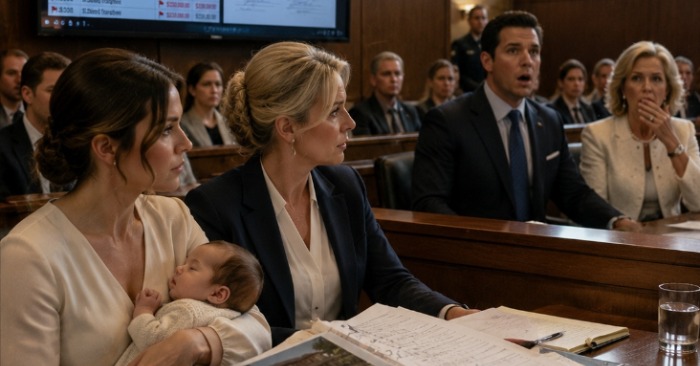
At the temporary custody hearing, Trevor arrived in a charcoal suit.
Diane sat directly behind him.
She wore pearls and a concerned expression.
Their attorney described the Hayes estate as a secure multigenerational home.
He said I had taken a newborn without warning.
He emphasized that I had no current employment.
Then Elena stood.
“My client left after her husband demanded a divorce while she was holding their infant son at four-thirty in the morning.”
Trevor’s attorney objected.
The judge allowed her to continue.
Elena submitted the messages he sent afterward.
Then the voicemail from Diane.
The judge listened to the phrase before this becomes embarrassing twice.
Temporary custody remained with me.
Trevor received supervised visitation until a full evaluation could be completed.
His confident expression disappeared.
Outside the courtroom, he approached me.
“You’re trying to destroy me.”
I shifted Caleb higher against my shoulder.
“No.”
“I’m trying to stop you from deciding the truth for everyone.”
His eyes moved toward Elena.
“You hired someone who does not understand our family.”
Elena stepped between us.
“Any further communication goes through counsel.”
Diane walked closer.
Her smile was thin.
“You will regret humiliating us.”
I looked at her.
“I was cooking your breakfast two months after giving birth.”
“You watched your son throw me away.”
“I am finished being afraid of your opinion.”
For the first time, she had no immediate answer.
The financial discovery process began.
Trevor claimed many documents no longer existed.
Servers had failed.
Files had been misplaced.
Accountants had changed.
Unfortunately for him, I had kept copies.
Every missing statement appeared in Elena’s evidence file.
Every deleted invoice existed as a photograph.
Every altered spreadsheet could be compared with an earlier version I had downloaded.
The more the Hayes family denied, the clearer the pattern became.
Then we found the house.
Not the estate where we had been living.
The house Trevor claimed was being built for us.
It had been completed eight months earlier.
But it was not empty.
A woman named Sabrina Cole lived there.
She worked as marketing director for Hayes Hospitality.
She had also been having an affair with Trevor for nearly a year.
The property deed listed a Hayes subsidiary as owner.
Construction had been paid from our marital account.
Furniture had been charged to a corporate card connected to my investment funds.
Trevor had built a second home with my money and placed his mistress inside it.
I expected the discovery to break me.
Instead, it made everything simpler.
There was no marriage to save.
Only evidence to organize.
Sabrina was subpoenaed.
At first, she claimed she believed Trevor was separated.
Then Elena showed her messages sent while I was pregnant.
Trevor had promised Sabrina that after the baby arrived, I would become “too dependent to fight.”
Another message read:
Mom says Naomi will leave quietly once she understands she has no money of her own.
Diane had known.
Not merely about the divorce.
About the affair.
About the plan.
Sabrina began cooperating when she learned Trevor had told her the house would eventually be hers.
It could not be transferred without exposing the diverted funds.
He had lied to both of us.
The full hearing occurred five months after I left.
Trevor entered court believing the dispute concerned custody, support, and division of property.
Then Elena began presenting the financial timeline.
My premarital investment account contained $1.8 million when we married.
Most came from stock options and profit-sharing earned during my accounting career.
The prenuptial agreement protected it.
Over three years, $1.26 million had been transferred without valid authorization.
Some funded the Hayes estate.
Some funded the second house.
Some paid personal expenses for Trevor’s parents and sister.
There were luxury vacations.
Vehicles.
Credit-card balances.
A business loan for Trevor’s brother-in-law.
Then came the forged signatures.
A forensic document examiner testified that several were not mine.
Digital records showed the files were created from Trevor’s office computer.
The hospital forms I had actually signed were produced.
The extra transfer pages used a copied signature image.
Trevor’s attorney requested a recess.
The judge refused.
Diane sat rigidly behind her son.
Then Elena introduced the estate records.
The Hayes family had presented the mansion as inherited wealth.
In fact, it had been weeks from foreclosure before my funds entered the holding company.
The judge looked toward Trevor.
“Did your wife know her protected assets were being used to preserve this property?”
He swallowed.
“She benefited from living there.”
“That was not my question.”
“No.”
“Did she authorize the transfer?”
“I believed she would.”
The judge stared at him.
“Belief is not authorization.”
Trevor’s perfect life began falling apart one answer at a time.
His family’s attorney argued that the money had become marital through commingling.
Elena produced emails in which Trevor explicitly described the funds as mine and promised they would remain protected.
One read:
Your account will stay untouched. I would never risk what you built before me.
The court ordered a full forensic accounting.
Liens were placed against both properties.
Several Hayes corporate accounts were frozen.
The divorce hearing paused while investigators reviewed possible criminal conduct.
Trevor blamed me publicly.
He told friends I was bitter because he wanted to leave.
Then portions of the financial findings became part of the public court record.
Invitations stopped arriving.
Business partners requested audits.
A hospital foundation removed Diane from its board after discovering that some charitable-event expenses had been paid through accounts containing my diverted money.
The Hayes name did not disappear.
But the admiration surrounding it did.
Trevor eventually agreed to a settlement to avoid a longer trial.
The estate was sold.
The second house was also sold.
After mortgages, taxes, and legal costs, enough remained to repay most of my protected funds.
I received primary custody of Caleb.
Trevor received structured visitation and was required to complete parenting counseling.
The court ordered him to pay support based on his actual earning capacity, not the reduced salary he suddenly claimed.
He lost his executive role when the Hayes company’s board discovered he had used business entities for personal transfers.
Diane moved into a smaller home.
She never apologized.
She sent one letter accusing me of dismantling a family legacy.
I returned it unopened.
A legacy built with someone else’s stolen money was only a performance.
The criminal investigation ended with a plea agreement.
Trevor admitted to financial fraud and document falsification.
He avoided prison but received probation, restitution requirements, and professional restrictions.
The public consequences mattered less to me than the private ones.
He had to sit in a courtroom and hear strangers describe the work I performed before marriage.
My expertise.
My savings.
My decisions.
For years, his family had treated me as though I contributed nothing because my labor happened inside their home.
The records told another story.
I had financed their comfort.
Maintained their household.
Protected their reputation.
Cared for their grandson.
And documented the truth they believed I was too exhausted to understand.
Ruth never asked me to leave her blue house.
I stayed for four months.
Then I rented a modest apartment with large windows and a small balcony.
It was not a mansion.
The kitchen counters were scratched.
The hallway light flickered.
I loved every inch of it.
No one criticized when I ate cereal for dinner.
No one woke me before sunrise to cook.
No one entered my room without knocking.
When Caleb was old enough to crawl, Ruth came over and placed cushions around the coffee table.
She watched him laugh on the carpet.
“You look different,” she said.
“How?”
“Visible.”
The word stayed with me.
I eventually returned to accounting.
At first, I accepted part-time forensic work from home.
Then Elena began referring clients whose spouses hid assets through family businesses.
I understood the patterns.
The missing statements.
The sudden passwords.
The insistence that asking questions meant disloyalty.
Three years later, I opened a small financial-investigation firm specializing in divorce and elder exploitation cases.
I called it Quiet Record Consulting.
Trevor saw the name on a document during a later custody review.
He looked at me across the courthouse hallway.
“Was all of this your plan?”
“No.”
“My plan was to stay married.”
His face tightened.
“You ruined my family.”
I looked toward Caleb, who was waiting beside Ruth with a picture book.
“No.”
“You asked me to leave because you thought I had nothing.”
“I simply believed you.”
Trevor had no answer.
Our son grew up knowing his father.
I never hid what happened, but I waited until Caleb was old enough to understand.
I did not teach him that Trevor was a monster.
People are more dangerous when we pretend only monsters cause harm.
His father had been selfish.
Dishonest.
Weak enough to let his family’s approval matter more than his wife’s safety.
He also loved his son in the limited way he knew how.
Over time, Trevor became more dependable.
Not because I forgave the marriage.
Because consequences finally demanded growth.
On Caleb’s fifth birthday, Trevor arrived early for the party at a public park.
He brought one gift.
Stayed within the agreed schedule.
Helped clean afterward.
Before leaving, he paused near my car.
“I should have looked at him that morning.”
I knew exactly what he meant.
At 4:30 a.m., when he entered the kitchen and asked for a divorce, he had not looked at the baby in my arms.
“Yes,” I said.
“I thought I was ending something.”
He looked toward Caleb playing near the swings.
“I did not understand what I was teaching him.”
“What were you teaching him?”
“That a woman’s work disappears if no one pays her.”
I studied him.
For once, he was not asking me to comfort him.
So I answered honestly.
“Make sure he learns differently from you.”
“I will.”
Whether he kept that promise was no longer mine to control.
That was another freedom I had earned.
The navy suitcase remained in my closet for years.
Its handle was cracked.
One wheel no longer turned properly.
I could have replaced it.
I never did.
It reminded me that the morning I appeared to leave with almost nothing, I carried everything that mattered.
My son.
The truth.
And enough evidence to make certain that the people who erased me inside their home could not erase me in court.