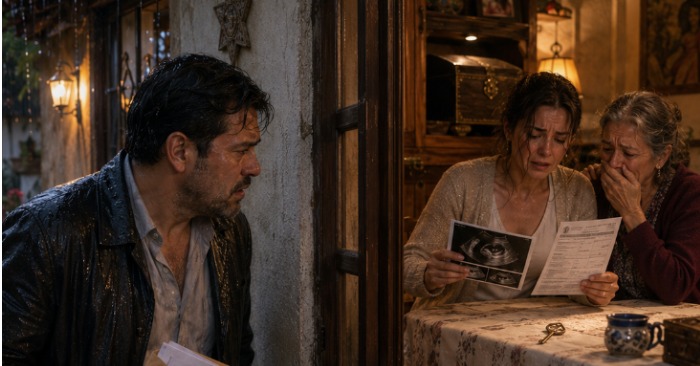
The envelope slipped from Mauricio’s hand.
It struck the tiled step and opened.
Divorce papers scattered across the courtyard.
For several seconds, he could not move.
Inside the house, Elena continued speaking.
Her voice sounded weak.
Not distant.
Not cold.
Weak.
“I have already signed the consent forms,” she told her mother.
Teresa began crying harder.
“You should have told him the day you received the diagnosis.”
“And watched him destroy everything to save me?”
“He loves you.”
“That is why I stayed silent.”
Mauricio pressed one hand against the wall.
Every suspicion he had carried for the past year suddenly looked cruel.
The missed calls.
The hidden appointments.
The tears she wiped away before entering their home.
He had interpreted all of it as betrayal.
She had been preparing to die without disrupting his life.
Teresa lowered her voice.
“You are already disrupting his life. He thinks you no longer love him.”
Elena looked toward the floor.
“That may make it easier for him afterward.”
“No.”
Her mother’s voice hardened.
“It will make him believe your final year together was a lie.”
Elena closed her eyes.
“I would rather he hate me than bury his future beside me.”
Mauricio wanted to enter.
He wanted to throw open the door and demand why she believed she had the right to decide what he could survive.
But then Elena removed a small metal key from her handbag.
She placed it on the table.
“If I do not wake up, give him this.”
Teresa stared at it.
“The old station key?”
Elena nodded.
“There is a box in the storage room beneath the abandoned railway office.”
“What did you put inside?”
“Everything he deserves to know.”
Her mother touched the key.
“About your illness?”
“About us.”
Mauricio looked at the symbol engraved into the metal.
Three interlocking lines inside a circle.
He had seen it once before.
Nine years earlier.
On a letter that changed his life.
At the time, Mauricio’s construction company consisted of one rusted truck, four employees, and more debt than contracts.
He was close to closing it.
Then an anonymous investor paid the deposit on a municipal restoration project and personally guaranteed the material costs.
The only message attached to the transfer had been brief.
Build honestly. Repay kindness by creating work for others.
The letter bore the same symbol.
Mauricio had searched for the sender.
The bank refused to release the information.
He eventually completed the project, won larger contracts, and built the business that now employed nearly sixty people.
He had always believed an unknown businessman had taken a chance on him.
Why did Elena possess the same symbol?
Inside, a chair scraped against the floor.
Mauricio quickly gathered the scattered divorce papers and stepped away from the window.
The front door opened moments later.
Elena emerged first.
Her face was pale.
She looked even thinner than she had that morning.
When she saw him, she stopped.
“Mauricio?”
He held the brown envelope behind his leg.
Teresa appeared beside her daughter and immediately noticed the papers in his hand.
Her expression changed.
“What are you doing here?” Elena asked.
He had practiced his answer during the entire drive.
He had planned to say that their marriage was over.
Now the words felt poisonous.
“I came to speak with you.”
Elena looked toward the envelope.
“About what?”
Mauricio could not tell her he had listened through the window.
Not yet.
Fear still controlled her.
If he confronted her publicly, she might close herself away again.
So he made a different choice.
“I thought we could have lunch.”
Confusion crossed her face.
“We haven’t had lunch together in months.”
“I know.”
She looked toward her mother.
Teresa understood immediately that something had happened.
But she said nothing.
Elena finally nodded.
“Give me a minute.”
While she returned inside for her coat, Teresa remained near the door.
Her eyes dropped to the envelope.
“Are those what I think they are?”
Mauricio answered quietly.
“They were.”
She stared at him.
“You heard us.”
He nodded.
Teresa exhaled.
“She will be furious.”
“I am furious.”
“Not at her illness.”
“No.”
He looked toward the room where Elena had disappeared.
“At the fact that she decided I would rather lose her without knowing.”
Teresa’s expression softened.
“She is terrified.”
“So am I.”
“She thinks love means preventing you from sacrificing anything.”
“She should know love means allowing me to choose.”
Teresa pressed the key into his palm.
Mauricio looked down.
“What are you doing?”
“She wanted you to receive it after the surgery.”
“I need it now.”
“She will never forgive me.”
“She may not forgive either of us.”
Teresa closed his fingers around the key.
“But perhaps she will live long enough to try.”
Elena returned wearing a dark coat.
She looked from her mother to Mauricio.
Neither spoke.
During the drive home, rain swept across the windshield.
Elena sat with both hands folded in her lap.
Mauricio remembered how she used to rest one hand on his knee whenever they stopped at traffic lights.
He wanted to reach for her.
Instead, he asked, “Are you working tomorrow?”
“No.”
“Hospital appointment?”
Her face tightened.
“Routine tests.”
Another lie.
Small.
Careful.
Meant to protect him.
It still hurt.
“When did we stop telling each other the truth?” he asked.
Elena turned toward the window.
“I don’t know.”
“I think you do.”
She remained silent.
At home, Mauricio placed the envelope on the kitchen table.
Elena looked at it.
“What is that?”
He pulled out the papers.
Her face went completely still.
“Divorce documents,” he said.
She did not cry.
She simply nodded.
“I understand.”
That response hurt more than anger would have.
“You understand?”
“You deserve someone who can give you a normal life.”
“I thought you no longer loved me.”
She looked away.
“I never said that.”
“You made sure I felt it.”
Her eyes filled.
“That was easier.”
“For whom?”
She had no answer.
Mauricio placed the engraved key beside the papers.
Elena stared at it.
Then she looked toward him in horror.
“My mother gave you that?”
“I heard everything.”
She stood abruptly.
“You listened to a private conversation?”
“I came to end our marriage and heard my wife say she might not survive surgery.”
Her anger collapsed.
He continued.
“You let me believe there was someone else.”
“There was never anyone else.”
“You let me spend a year thinking I had failed you.”
“I was trying to save you.”
“By teaching me to mourn you before you were gone?”
Elena began crying.
Mauricio had imagined this confrontation many times.
In those imagined versions, she confessed to an affair.
He remained calm.
He walked away with dignity.
The truth offered no such clean escape.
He crossed the kitchen and held her shoulders.
“What is wrong with your heart?”
She shook her head.
“It is not exactly my heart.”
“Then tell me.”
Doctors had found a rare vascular tumor behind her chest wall.
It pressed against major arteries near her heart.
Removing it was dangerous.
Leaving it untreated was worse.
The surgery had been scheduled for the following week.
The medical team estimated that she had a real chance of survival.
But they could not guarantee she would wake without serious complications.
“How long have you known?”
“Eleven months.”
The same period during which she became distant.
“Eleven months,” Mauricio repeated.
“I wanted one more normal year.”
“This was not normal.”
“I know.”
“Did you think I would not notice you disappearing?”
“I hoped you would become angry enough to let me go.”
He stared at her.
“You succeeded.”
She covered her mouth.
Mauricio immediately regretted the cruelty of the words.
But he did not withdraw them.
Love did not erase damage.
He picked up the key.
“What is in the box?”
Elena wiped her face.
“It does not matter.”
“It mattered enough to hide for nine years.”
She looked at him sharply.
“You recognized the symbol.”
“The letter that saved my company carried it.”
Elena sat down.
For the first time that evening, she looked defeated.
“My father used that symbol.”
“You told me your father abandoned you.”
“He did.”
Teresa had raised Elena alone after her husband disappeared.
That was the story Mauricio knew.
The truth was more complicated.
Elena’s father, Rafael Ortega, had built a successful engineering firm.
When Elena was fifteen, he discovered his business partner was laundering money through public construction contracts.
Rafael agreed to testify.
Before he could, the partner threatened Elena and Teresa.
Rafael entered witness protection and vanished from their lives.
For years, Elena believed he had chosen safety over his family.
Then, shortly before she met Mauricio, she received a letter from him.
He was dying.
He had secretly followed Elena’s life from a distance and left her a protected inheritance.
Not an enormous fortune.
Enough to give her security.
She used part of it to save Mauricio’s company anonymously.
“You were the investor,” he whispered.
Elena nodded.
“Why didn’t you tell me?”
“You would have refused.”
“You did not know me well enough to decide that.”
“I knew you were proud.”
“You made me believe a stranger trusted me.”
“I did trust you.”
“Then why hide?”
“Because I wanted you to know you succeeded through your work, not because your wife rescued you.”
He sat across from her.
“You changed my entire life.”
“You changed mine first.”
“How?”
She smiled sadly.
“The first time I met you, you were arguing with a supplier who wanted you to use cheaper materials in a school renovation.”
Mauricio remembered.
He had lost money on that contract because he refused.
“You said children should not pay for adult dishonesty,” Elena continued.
“My father had spent years fighting people who believed the opposite.”
She had fallen in love with him before he realized she was watching.
The hidden box contained Rafael’s final letters, documents proving the investment came from Elena, and one legal instrument transferring the remaining funds into a foundation for workers injured on construction sites.
Mauricio drove to the abandoned railway office that night.
Elena went with him.
They found the box beneath a loose floorboard in the storage room.
Inside were photographs of Rafael.
Letters to Elena.
Copies of the original bank transfer.
And a sealed envelope addressed to Mauricio.
He opened it carefully.
Mauricio,
You do not know me, but my daughter believes you are an honest man. I have learned that honest men often refuse help because they fear help will own them. This money owns nothing. Use it to build. Use it to employ. Most importantly, never allow pride to make you confuse silence with strength.
Mauricio stopped reading.
Elena began crying.
Her father’s final warning had described both of them.
Mauricio had allowed wounded pride to turn distance into suspicion.
Elena had allowed fear to turn love into secrecy.
They had nearly ended their marriage while each believed they were protecting what mattered.
The following morning, Mauricio called his attorney.
He did not cancel the divorce papers immediately.
He placed them in a drawer.
Not as a threat.
As proof that marriage could not survive on love alone.
Then he called his business manager.
“I need to take time away.”
The manager panicked.
“We have three active projects.”
“You can handle them.”
“I have never run the company without you.”
“That is why I hired you.”
Elena overheard.
“I told you this would happen.”
Mauricio turned toward her.
“No.”
“What?”
“You said I would sell everything and destroy the company.”
“I know you.”
“You knew the man I was nine years ago.”
He took her hand.
“I built a company strong enough to survive without me for a while.”
“I do not want you to stop living.”
“I am not stopping.”
He looked at her.
“I am choosing where my life belongs this week.”
She tried to argue.
He did not let her.
“You do not get to decide what I am willing to risk.”
Neither did he make reckless promises.
He did not mortgage the house.
He did not sell the company.
He created a temporary leadership plan, reviewed their insurance, arranged medical leave, and asked friends for help.
Love became practical.
Medication schedules.
Hospital bags.
Legal forms.
Quiet nights when neither pretended not to be afraid.
The surgery lasted eleven hours.
Teresa and Mauricio waited together.
At one point, Teresa took the brown divorce envelope from his bag.
“You brought it?”
“I carry it when I need to remember how close we came to making the wrong decision.”
She gave it back.
Near midnight, the surgeon entered.
His expression was exhausted.
“The tumor has been removed.”
Mauricio stood.
“And Elena?”
“She is alive.”
The relief hit so hard that he gripped the chair.
The surgeon continued.
“The next forty-eight hours are critical.”
Elena did not wake that night.
Or the next morning.
Mauricio sat beside her, holding her hand and reading Rafael’s letters aloud.
He told her every truth they had avoided.
That he had felt abandoned.
That he was angry.
That he loved her.
That forgiveness would require work from both of them.
On the second evening, her fingers moved.
Only slightly.
Then her eyes opened.
She looked at him through confusion and pain.
“You sold the company?”
His laugh turned into a sob.
“No.”
“Mortgaged the house?”
“No.”
“You stayed?”
“Yes.”
Her eyes closed again.
This time, peacefully.
Recovery took nearly a year.
Elena struggled with weakness and nerve damage in one arm.
Mauricio struggled with resentment that surfaced unexpectedly.
They entered counseling.
Not because their marriage lacked love.
Because love had nearly been suffocated by decisions made without the other person’s consent.
Elena learned to say when she was afraid instead of disappearing emotionally.
Mauricio learned to ask questions without turning uncertainty into accusation.
Some nights were difficult.
Some conversations ended in silence.
But it became an honest silence.
Not one filled with invented betrayals.
On their tenth anniversary, they returned to Teresa’s house in Coyoacán.
The same window remained open.
Mauricio placed the brown envelope on the table.
Elena looked at it.
“You kept those?”
He nodded.
“Why?”
“To remember that I arrived here certain our marriage was over.”
“And then you listened through a window.”
“I prefer to call it an accidental intervention.”
She smiled.
Then she took the papers from the envelope.
Without ceremony, they fed them into Teresa’s old kitchen shredder.
The machine groaned.
Teresa laughed from across the room.
“That thing has not worked properly in years.”
The papers jammed halfway through.
Mauricio and Elena stared at the crooked pages hanging from the machine.
Then both began laughing.
It was not a perfect symbolic ending.
It was better.
Real.
Messy.
Alive.
Later, they established the Rafael Ortega Fund using the remaining inheritance.
It provided emergency support to small contractors who refused corrupt deals and to families facing major medical crises.
The first grant went to a carpenter whose wife needed heart surgery.
When Mauricio handed him the approval letter, the man began crying.
“I do not know how I will repay you.”
Mauricio remembered Rafael’s words.
“Build honestly.”
Then he added something he had learned from Elena.
“And when you are afraid, tell the people who love you before fear begins speaking for them.”
Mauricio had arrived at his mother-in-law’s house believing silence meant the absence of love.
He learned that silence could also be love distorted by terror.
That did not make secrecy harmless.
It made truth even more urgent.
Elena survived because medicine saved her body.
Their marriage survived because they finally stopped trying to protect each other from choices they deserved to make together.
And the envelope Mauricio once carried as an ending became a reminder:
Sometimes the moment a relationship appears finished is the exact moment the truth finally asks to be heard.