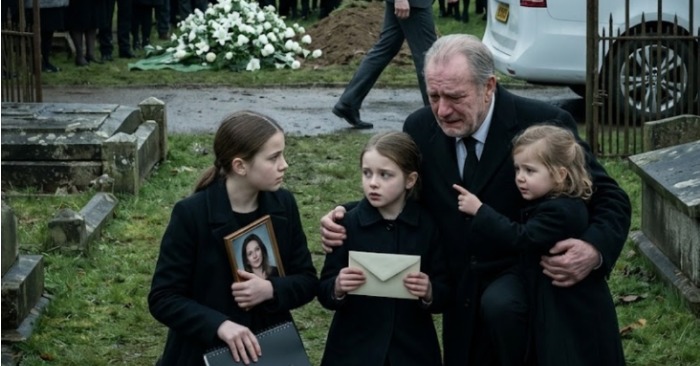
Arthur’s white van disappeared beyond the cemetery gates.
Only then did Lucy begin to cry.
Not loudly.
Her shoulders trembled while she continued staring at the empty road, as though part of her still expected her father to come back and say he had made a terrible mistake.
He did not.
I placed one hand on her shoulder.
“You don’t have to be strong for your sisters anymore.”
She looked up at me.
“Yes, I do.”
The answer broke something inside me.
No twelve-year-old should have spoken like that.
Rachel still had not said a word.
April remained wrapped around my arm, her small fingers buried in the sleeve of my coat.
Behind us, mourners began leaving in quiet groups.
Some offered condolences.
Others apologized for Arthur, as though cruelty could be explained by grief.
I knew better.
That man had not looked heartbroken.
He had looked relieved.
My sister Margaret approached and whispered, “Charles, I can take the girls tonight while you organize things.”
Lucy immediately tightened her grip on the overnight bag.
“No.”
Margaret blinked.
Lucy stepped closer to me.
“We stay with Grandpa.”
There was fear in her voice.
Not uncertainty.
Fear.
I nodded.
“They’re coming with me.”
The priest offered to contact a family lawyer, but I told him I already knew one.
Before retiring, I had spent thirty-eight years working as a probate attorney.
Arthur seemed to have forgotten that.
He also seemed to have forgotten that my daughter had always told me where her important documents were kept.
At least, I believed she had.
As we reached my car, Lucy looked around to make certain no one was watching.
Then she opened the overnight bag.
Beneath three folded dresses and April’s stuffed rabbit lay a black notebook wrapped in a blue scarf.
Beside it was a digital voice recorder.
At the bottom rested a cream envelope sealed with red wax.
My name was written across it.
“Where did you get these?” I asked.
“Mom gave us instructions,” Rachel finally whispered.
Her voice was so quiet I barely heard her.
“When?”
“Two weeks before she went to the hospital.”
I stared at them.
Rose had supposedly collapsed without warning.
Arthur told us she had suffered a sudden cardiac event while alone in the bedroom.
He claimed he found her too late.
Now I wondered how much of that story had been true.
Lucy placed the envelope in my hands.
“Mom said we had to wait.”
“For what?”
“For Dad to leave us.”
The cemetery seemed to tilt beneath my feet.
“She knew he would?”
Lucy nodded.
“She said he would choose Vanessa.”
The name meant nothing to me.
“Who is Vanessa?”
The girls exchanged another silent look.
Then April answered.
“The sunglasses lady.”
Arthur’s fiancée.
The woman waiting in the van while my daughter was being buried.
I drove the girls to my house without opening the envelope.
I wanted them somewhere safe first.
During the journey, April fell asleep against Rachel’s shoulder.
Lucy watched every car behind us.
At one point, she asked, “Can Dad take us back?”
“Not tonight.”
“What about tomorrow?”
“I won’t let anyone remove you without a judge hearing the truth.”
She turned toward the window.
“You don’t know the truth yet.”
She was right.
My house had always been quiet after my wife died.
That evening, it filled with small shoes, whispered questions, and the sound of drawers being opened as I tried to find extra blankets.
I prepared soup.
None of the girls ate much.
At nine o’clock, Rachel took April upstairs and helped her into bed.
Lucy remained at the kitchen table.
The black notebook sat between us.
“Did your mother tell you what was inside?”
“Some of it.”
“Why didn’t she tell me?”
“Dad checked her phone.”
The calm way she said it frightened me.
“He read her messages. He listened outside doors. He told her you were too old to help.”
I pulled out a chair.
“Lucy, did your father ever hurt your mother?”
Her eyes dropped.
“He never hit her where people could see.”
I closed my eyes.
For years, Rose had told me she was tired.
Stressed.
Overwhelmed.
Whenever I asked if Arthur was treating her well, she smiled and said marriage was difficult sometimes.
I had accepted the answer because I wanted to believe her.
That failure would remain with me forever.
I opened the notebook.
The first pages were ordinary.
Grocery lists.
School schedules.
Medical appointments.
Then the entries changed.
Dates appeared in the margins.
Amounts of money.
Names of medications.
Descriptions of arguments.
Arthur removed my bank card again.
Arthur told the girls I was unstable.
Vanessa came after midnight.
He says the new tablets will help me sleep.
They make my heart race.
I turned the page.
There were photographs taped inside.
Arthur kissing the woman from the van outside a hotel.
Arthur entering a private clinic with a man whose face had been circled in red.
A pharmacy receipt for medication that had never been prescribed to Rose.
My stomach tightened.
Lucy pointed toward the recorder.
“She used that after he started deleting things.”
I pressed play.
For several seconds, there was only static.
Then my daughter’s voice filled the kitchen.
Weak.
Unsteady.
“Arthur, these pills are making me sick.”
His reply came sharply.
“The doctor said you need them.”
“I called the doctor. He said he never prescribed these.”
Silence.
Then Arthur spoke again.
“You’re confused, Rose.”
“I’m not confused.”
“You’ve been unstable for months.”
“I know about Vanessa.”
The recording ended abruptly.
Lucy stared at the table.
“There are more.”
The second recording captured Arthur and Vanessa speaking in the kitchen.
The voices were faint but clear enough.
“She’s asking questions,” Vanessa said.
Arthur answered, “Then stop coming here during the day.”
“What about the insurance?”
“Once the policy clears, we won’t have to hide anymore.”
My hand froze above the recorder.
Insurance.
I flipped through the notebook faster.
Near the back, Rose had copied information from a life insurance policy.
Arthur was the sole beneficiary.
The value was two million dollars.
The policy had been increased only four months before her death.
That alone did not prove murder.
But it was enough to make my instincts scream.
I opened the envelope.
Inside was a handwritten letter, a notarized guardianship petition, and a small key.
Dad,
If you are reading this, Arthur has abandoned the girls exactly as he threatened he would.
Please believe that I tried to leave.
He took my documents and convinced people I was emotionally unstable.
He has been giving me medication that was not prescribed to me.
I hid samples in a locked box at the Lakeside Storage Facility.
The key is enclosed.
Do not confront him alone.
Protect my daughters first.
Then stop his wedding.
At the bottom, Rose had written one final sentence.
Vanessa knows more than she admits, but she is not the person Arthur thinks she is.
I read that line three times.
“What does that mean?” Lucy asked.
“I don’t know.”
My phone rang before I could say more.
Arthur.
I let it ring.
A message followed.
I’ll sign temporary custody tomorrow. Don’t make this difficult.
Then another arrived.
You’ll need money for three children. We can discuss an arrangement if you stay out of my personal life.
He believed I could be purchased.
That was his second mistake.
By midnight, I had contacted my former law partner, a family court judge, and Detective Lena Morris, who had once worked with my firm on financial abuse cases.
Lena came to the house personally.
She listened to the recordings.
She photographed every notebook page.
Then she asked to speak with each girl separately, with a child advocate present.
April spoke last.
She sat on my sofa holding her stuffed rabbit.
“Did you see anyone in your mother’s room the night she became sick?” Lena asked gently.
April nodded.
“Daddy.”
“Anyone else?”
“The sunglasses lady.”
“What were they doing?”
April twisted the rabbit’s ear.
“Daddy was angry because Mommy spit the drink out.”
Lena remained calm.
“What drink?”
“The purple one.”
My pulse quickened.
“Did your mother usually drink something purple?”
April shook her head.
“The lady put drops in it.”
The room became painfully still.
“Did your mother drink it?”
“A little.”
“What happened next?”
“She fell near the bed.”
April’s lip trembled.
“Daddy told us she was sleeping.”
I turned away so she would not see my face.
The following morning, police searched the storage unit named in Rose’s letter.
Inside the locked box were medication bottles, laboratory results, printed emails, and two sealed containers.
One contained tablets prescribed under another person’s name.
The other held residue from the drink April had described.
The analysis would take time.
Arthur did not wait for the results.
Three days after the funeral, he announced his engagement publicly.
He and Vanessa planned to marry in six weeks at the Grand Marlowe Hotel.
The announcement described their relationship as an unexpected love born from shared grief.
There was no mention of Rose.
There was no mention of his daughters.
When reporters asked about them, Arthur claimed they were temporarily staying with their grandfather while he “healed.”
Lucy saw the interview on television.
“He’s lying again.”
“Yes.”
“Are you going to stop him?”
I looked toward Rose’s notebook.
“Your mother asked me to.”
The court granted me emergency guardianship.
Arthur did not contest it.
That surprised the judge.
It did not surprise me.
Arthur wanted freedom more than he wanted his children.
What he did not know was that Detective Morris had quietly reopened the investigation into Rose’s death.
The toxicology results arrived two weeks later.
Rose had been exposed repeatedly to a heart medication that was not prescribed to her.
In controlled doses, it could cause dizziness and irregular heartbeat.
Combined with another substance found in the drink residue, it could become deadly.
The private clinic in Rose’s photographs had supplied the medication illegally.
Financial records connected the clinic to Arthur.
Yet one question remained.
Why had Vanessa allowed Rose to photograph her?
Why had she helped prepare the drink?
And what had Rose meant when she wrote that Vanessa was not who Arthur believed she was?
The answer came from the final recording.
It had been stored under a different date and overlooked at first.
Rose’s voice began quietly.
“Say your real name.”
A woman replied.
“Vanessa Cole.”
“No. The name before that.”
There was a long pause.
Then she answered.
“Emily Grant.”
Detective Morris searched the name.
Emily Grant was not a socialite.
She was a former financial investigator whose younger brother had lost his savings in an investment scheme connected to Arthur.
She had approached him under a false identity to gather evidence.
At first, she had planned only to expose his fraud.
Then she discovered what he was doing to Rose.
The recording continued.
“I never agreed to hurt you,” Emily said.
“You brought him the medication.”
“I switched most of it. I thought I was buying you time.”
“Then help me prove it.”
“I’m trying.”
“If something happens to me, protect the girls.”
“I will.”
Emily had not been Arthur’s loyal accomplice.
She had been trapped inside her own deception.
But she had still crossed lines.
She had supplied illegal medication, concealed evidence, and failed to call the police when Rose was in danger.
Detective Morris found her before the wedding.
Emily agreed to cooperate.
She revealed that Arthur planned to marry her quickly, access money he believed she had inherited, and then leave the country once Rose’s insurance payout arrived.
Emily never intended to reach the altar.
Neither did the police.
On the morning of the wedding, Arthur entered the Grand Marlowe ballroom wearing a black tuxedo and the smile of a man convinced he had erased his old life.
Nearly three hundred guests waited beneath crystal chandeliers.
He believed Emily would walk down the aisle.
Instead, the doors opened and Lucy entered.
Rachel and April walked beside her.
I followed several steps behind.
A murmur swept through the room.
Arthur’s face hardened.
“What are they doing here?”
Lucy carried Rose’s framed photograph.
Rachel held the black notebook.
April carried the sealed evidence bag containing the purple bottle.
Arthur stepped away from the altar.
“Charles, get them out.”
I continued walking.
“You announced at their mother’s funeral that you wanted a fresh start.”
He glanced toward the guests.
“This is not the place.”
“You chose the cemetery.”
The room fell silent.
Then speakers hidden near the stage came alive.
Rose’s voice filled the ballroom.
“Arthur, these pills are making me sick.”
His recorded answer followed.
“You’re confused, Rose.”
Arthur’s face drained of color.
He lunged toward the control table.
Two officers stepped into his path.
Detective Morris approached from the side aisle.
“Arthur Reed, do not move.”
He looked desperately toward the bridal entrance.
“Vanessa!”
Emily appeared behind the officers.
She was not wearing a wedding dress.
She wore a plain dark suit.
“You set me up,” Arthur whispered.
She looked at the three girls.
“No. Their mother did.”
Detective Morris placed him under arrest on suspicion of fraud, coercive control, evidence tampering, and involvement in Rose’s death.
Additional charges would follow.
Some guests began crying.
Others quietly left, ashamed that they had celebrated a man whose wife had been buried only weeks earlier.
Arthur kept insisting there had been a misunderstanding.
He claimed Rose was unstable.
He called the recordings fake.
Then April stepped forward.
For the first time, he looked directly at his youngest daughter.
“Tell them,” he demanded. “Tell them Daddy loved Mommy.”
April tightened her arms around her rabbit.
“You told us good children keep secrets.”
Arthur’s mouth opened.
Nothing came out.
She looked toward Detective Morris.
“But Grandpa says good children ask for help.”
That was the moment Arthur stopped fighting.
The ballroom where he expected to begin a new life became the place where every lie he had built finally collapsed.
The trial lasted months.
Arthur was convicted on multiple charges connected to financial fraud, illegal medication, abuse, and Rose’s death.
Emily received a reduced sentence for cooperating, though the court made it clear that fear and regret did not erase responsibility.
The insurance money never reached Arthur.
It was placed into protected trusts for the girls.
But the inheritance they valued most was not money.
It was Rose’s notebook.
Lucy kept the original sealed inside a safety box.
Rachel copied her mother’s favorite memories into a blue journal.
April placed the little storage key beside a photograph of Rose smiling in the garden.
A year later, on the anniversary of their mother’s death, we returned to the cemetery.
There were no crowds.
No cameras.
No cruel announcements.
Only four people standing beside the grave.
Lucy placed three white roses near the headstone.
“One from each of us,” she said.
Rachel opened the notebook and read the final words Rose had written:
My daughters may be frightened, but they are not powerless.
They know the truth.
And someday, when they feel safe enough to speak, the truth will protect them.
April leaned against me.
“Did Mom know we would save her?”
I looked at the three brave girls she had fought so desperately to protect.
“She knew you would save each other.”
Arthur had believed abandoning his daughters would give him a fresh beginning.
Instead, it gave them the freedom to reveal everything he had tried to bury.
And Rose’s final act was not revenge.
It was a mother’s promise fulfilled from beyond the grave:
Her daughters would never be silenced again.