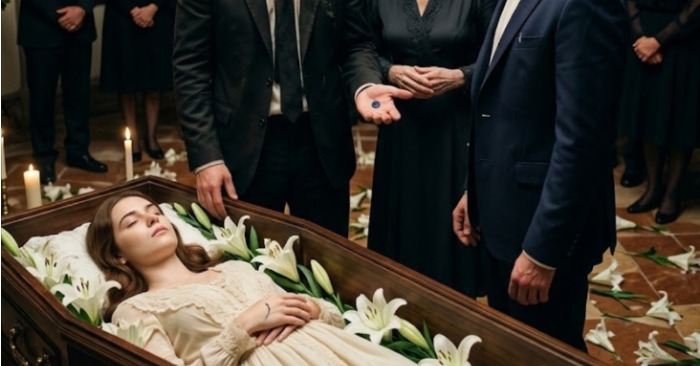
Dr. Méndez’s final words stayed with me all night.
“Come alone.”
“Tell nobody.”
“And Julián… do not let them cremate Camila.”
I stared through the office window at the dark vineyard stretching beyond the estate.
Somewhere downstairs, my mother was giving instructions about flowers.
Rodrigo was drinking with relatives.
And my wife lay inside a coffin while everyone behaved as though the truth had already been buried with her.
I slipped my hand into my pocket.
The button was still there.
Cold.
Smooth.
Real.
Camila had fought someone.
And before death took her, she had made sure I would know who stood close enough for her to tear that button free.
At four in the morning, I returned to the living room.
Only two candles remained lit.
The housemaids had gone to sleep.
Rodrigo sat near the coffin with an untouched whiskey glass.
His jacket lay folded across the back of a chair.
One button was missing from the front.
He noticed me looking.
“Old jacket,” he said casually. “Things fall off.”
I stepped closer.
“Camila’s fingernails didn’t.”
His smile vanished.
For one second, the man beneath the charm appeared.
Cold.
Calculating.
Then my mother entered.
“What are you two discussing?”
“Nothing,” Rodrigo said.
I looked at her.
“Why is the cremation scheduled so quickly?”
Teresa folded her hands.
“Because suffering should end.”
“Whose suffering?”
Her eyes hardened.
“Yours.”
“No.”
I glanced toward Camila’s coffin.
“You’ve never cared about mine.”
The silence between us was old.
Older than my marriage.
Older than Rodrigo’s jealousy.
My mother had always believed affection was weakness and control was love.
My father obeyed her until the day he died.
Rodrigo learned to imitate her.
I learned to survive her.
Camila was the first person who taught me that survival was not the same as living.
Teresa stepped closer.
“You are grieving. Sleep before you say something unforgivable.”
I looked directly at Rodrigo.
“I think the unforgivable thing has already happened.”
His hand tightened around the whiskey glass.
But neither of them stopped me when I left the room.
They still believed I was going upstairs.
Instead, I slipped out through the kitchen entrance.
At six exactly, I entered the hospital through the emergency corridor.
Dr. Ana Lucía Méndez was waiting in a small consultation room.
Her usually composed face looked exhausted.
She locked the door behind me.
“Show me your identification.”
I stared at her.
“You know me.”
“I need proof for the record.”
That frightened me more than anything she had said on the phone.
I handed her my wallet.
She photographed my identification, then placed a folder on the desk.
“Your mother brought Camila here shortly after midnight three days ago.”
I sat down slowly.
“Three days?”
“Yes.”
“But they told everyone she died yesterday.”
Ana nodded.
“Because yesterday was when they decided to inform you.”
My stomach turned.
“What condition was she in?”
Ana hesitated.
“Camila had suffered severe trauma.”
“What kind?”
“Bruising around both wrists.”
“A wound near the back of her head.”
“Signs that she had been restrained.”
The room became distant.
My hands went numb.
“And childbirth?”
“She had given birth recently.”
“Recently?”
Ana looked at me.
“She did not die during delivery.”
The sentence split my life in two.
Everything before it.
Everything after.
“Then how?”
“I cannot confirm the exact cause without an autopsy.”
“Which is why your mother wanted immediate cremation.”
I stood so suddenly the chair struck the wall.
“They murdered her.”
Ana did not answer.
She did not need to.
I leaned against the desk.
“My son.”
Her face changed.
Not with grief.
With fear.
“The baby was not with Camila when she arrived.”
My heart stopped.
“Then where is he?”
“I don’t know.”
“You called me here because you know something.”
“I know what one of the nurses heard.”
Ana opened the folder.
Inside was a written statement.
A night nurse had overheard Teresa arguing with Rodrigo near the private loading entrance.
My mother had said,
“The child cannot remain here.”
Rodrigo answered,
“He is the only leverage we have left.”
I read the sentence twice.
Then a third time.
The words refused to become real.
“My son is alive.”
Ana reached across the desk.
“He may be.”
That hope hurt more than grief.
Hope gave me something else to lose.
“What else?”
Ana removed a sealed plastic bag.
Inside was a hospital blanket.
White with a pale-green border.
A faint smear of blood marked one corner.
“This was found in Rodrigo’s vehicle after he demanded it be cleaned.”
“How did you get it?”
“The attendant thought the request was suspicious.”
Ana’s voice lowered.
“He also found a small tracking bracelet beneath the passenger seat.”
She placed it beside the blanket.
The bracelet carried a temporary newborn identification number.
No name.
But the date matched the night Camila died.
I closed my fingers around the plastic bag.
“Can it be traced?”
“The number was generated through our maternity system.”
“Someone deleted the registration.”
“Can you restore it?”
“My technicians are trying.”
A knock sounded at the door.
Ana went still.
Another knock.
Then a man’s voice.
“Doctor Méndez?”
She motioned for silence.
The door handle moved.
“Security inspection.”
Ana whispered,
“I didn’t request security.”
We left through a second door leading to the records corridor.
As we moved quickly toward the stairwell, I called the only person Camila and I had trusted with our emergency documents.
Attorney Lucía Ferrer answered immediately.
“Julián?”
“Activate the protection order.”
She did not ask why.
“Camila?”
“Dead.”
Lucía went silent.
“My son may be alive.”
Her voice changed.
“I’m calling the federal prosecutor.”
“No local police.”
“I understand.”
“And stop the cremation.”
“It was already stopped at five forty.”
I froze on the stairs.
“How?”
“Camila filed an advance legal directive six months ago.”
Lucía continued.
“If she died under unexplained circumstances, no burial or cremation could occur without an independent forensic review.”
A painful smile almost crossed my face.
Even now, Camila was fighting.
Ana and I reached the underground parking area.
My car stood where I had left it.
Beside it was a black SUV.
Rodrigo leaned against the hood.
He was no longer wearing sunglasses.
The scratch on his neck looked darker in the fluorescent light.
“You should have stayed home,” he said.
Ana stepped backward.
I moved in front of her.
“Where is my son?”
Rodrigo laughed quietly.
“You truly believe everything is about you.”
“Where is he?”
“You should ask your wife.”
My control slipped.
I grabbed his jacket.
He looked down at my hand and smiled.
“There he is.”
“The strong brother.”
“The one Camila kept promising was hidden inside.”
I shoved him against the SUV.
“Did you kill her?”
For the first time, fear flickered in his eyes.
Then he looked past me.
Two men were moving toward us from the stairwell.
Hospital security uniforms.
But their shoes were polished black leather.
Not hospital issue.
Rodrigo smiled.
“You arrived home early.”
My blood went cold.
He knew.
“You saw something, didn’t you?”
I released him.
“What happened that night?”
Rodrigo adjusted his collar.
“Camila confronted Mother.”
“About the missing vineyard money?”
“About everything.”
His face tightened.
“She had copies of accounts. Recordings. Signed invoices.”
“She threatened to expose us before the sale.”
“You were stealing from your own family.”
He shrugged.
“We were preserving it.”
“For yourselves.”
“For the people capable of running it.”
I stepped closer.
“And Camila?”
“She refused to understand.”
The two false guards were almost upon us.
Then sirens echoed through the garage.
Not local police.
Federal investigators.
Vehicles blocked both exits.
Rodrigo’s face changed.
The two men turned and ran.
They were caught before reaching the stairwell.
Lucía stepped from the lead vehicle beside three investigators.
She pointed toward Rodrigo.
“That man is named in an emergency protection filing involving suspected homicide, financial crimes, and the disappearance of a newborn.”
Rodrigo ran.
He made it ten feet.
An officer forced him to the ground.
As they restrained him, he shouted toward me,
“You won’t find the child without Mother!”
That was the first clear confirmation.
My son was alive.
I drove back to the estate with federal officers.
The funeral guests were still arriving when investigators entered through the front doors.
My mother stood beside the coffin.
For the first time in my life, I saw genuine panic on her face.
“What is this?” she demanded.
I walked toward her.
“An autopsy.”
She stepped in front of the coffin.
“No.”
One investigator presented the court order.
Teresa did not read it.
She tore it in half.
That single act ended the performance.
Relatives began whispering.
My aunt crossed herself.
The housemaids stared.
My mother turned toward me.
“You have destroyed this family.”
I pulled the navy button from my pocket.
“No.”
I held it where everyone could see.
“Camila died exposing what this family had become.”
Teresa’s gaze fixed on the button.
Then moved to Rodrigo’s damaged jacket, carried inside as evidence.
She knew there was no longer a lie large enough to cover everything.
“Where is my son?”
Her jaw tightened.
“What son?”
I walked closer.
“The baby Rodrigo called leverage.”
The room went silent.
My mother looked around at the relatives she had controlled for decades.
No one stepped forward to defend her.
“He was not supposed to survive,” she whispered.
My knees nearly failed.
“But he did?”
She said nothing.
I grabbed the edge of the table to keep myself upright.
“Where is he?”
Teresa’s eyes filled with something that almost resembled grief.
“Camila gave birth in the old guesthouse.”
Fragments began to fall into place.
The false funeral timeline.
The hospital arrival without records.
The newborn bracelet in Rodrigo’s car.
“Why there?”
“Because she went into labor while confronting us.”
My mother’s voice remained cold, as though recounting someone else’s tragedy.
“She had discovered the transfer documents.”
“She planned to call the authorities.”
“Rodrigo tried to take her phone.”
“She fought him.”
The button.
The scratch.
I could see it.
Camila clawing at him.
Protecting herself.
Protecting our child.
“She fell,” Teresa said.
“Rodrigo did not mean—”
“He struck her?”
“He pushed her.”
My mother’s voice cracked for the first time.
“She hit the stone fireplace.”
I closed my eyes.
The sound existed in my mind even though I had not been there.
“What did you do?”
“She was still breathing.”
“Then why didn’t you call an ambulance?”
Teresa looked at me.
And in that moment, I understood.
Because saving Camila meant exposing everything.
The theft.
The assault.
The child.
Their perfect family name.
“You let her die.”
“I protected what remained.”
I almost struck her.
My hand rose.
Then stopped.
Camila used to say my calm was protection.
I lowered it.
“No.”
“You protected your control.”
An investigator stepped forward.
“The child.”
Teresa looked toward the window.
“Rodrigo gave him to Marta.”
“Marta who?”
“The former housekeeper.”
My heart raced.
“Where?”
“She owns a small house outside Dolores Hidalgo.”
Federal officers were already moving.
I went with them.
The drive lasted forty minutes.
It felt like forty years.
Every possible ending passed through my mind.
A living child.
A dead child.
An empty house.
Another lie.
We found Marta sitting on a porch beneath a faded red blanket.
When she saw the vehicles, she stood.
Then she saw me.
Her face crumpled.
“Señor Julián.”
I ran toward her.
“Where is he?”
She began crying.
“I wanted to call you.”
“Where is my son?”
A baby cried inside the house.
The sound stopped my heart.
Marta stepped aside.
In a small bedroom, beneath a white mosquito net, lay my son.
Tiny.
Alive.
Wrapped in the green-bordered hospital blanket.
I fell to my knees beside the cradle.
His fist rested near his cheek.
Camila’s mouth.
My eyebrows.
A whole future breathing softly in front of me.
I lifted him with hands that had held contracts, land deeds, and my dead wife’s fingers.
Nothing had ever felt so fragile.
Nothing had ever felt so heavy.
“What did they tell you?” I asked Marta.
“That Señora Camila had abandoned him.”
“I knew it was a lie.”
“Why did you keep him?”
“Because they said they would kill him if I refused.”
She covered her face.
“I was waiting for a safe way to reach you.”
I pressed my lips to my son’s forehead.
Camila had died believing he might be taken.
I promised her silently that he would never again belong to anyone’s scheme.
The autopsy confirmed what my mother had tried to hide.
Camila died from head trauma and delayed medical treatment.
She might have survived if help had been called immediately.
That truth destroyed me more than the blow itself.
Rodrigo was charged with homicide, kidnapping, fraud, and conspiracy.
My mother was charged as an accomplice and for denying medical assistance, concealing evidence, and abducting my son.
The financial investigation uncovered years of stolen money and forged vineyard records.
At trial, Teresa still called herself the protector of the family.
The judge answered,
“A family is not protected by sacrificing the innocent.”
The vineyards survived.
But I did not keep them as they had been.
I sold the mansion.
Converted the old guesthouse into a refuge for women and children escaping family violence.
And placed Camila’s shares into a trust for our son.
I named him Mateo.
The name Camila had chosen months earlier.
Years later, Mateo asked me why one dark navy button sat inside a glass frame in my office.
I told him the truth carefully.
Not every brutal detail.
Only what a child could carry.
“Your mother was very brave,” I said.
“She left me a clue when she could no longer speak.”
He touched the glass.
“Did it help you find me?”
“Yes.”
He smiled.
“Then it’s not a sad button.”
I looked at him.
“What is it?”
“A brave one.”
That night, after he fell asleep, I placed Camila’s photograph beside the frame.
For years, I believed her final gift was the evidence hidden in her hand.
I was wrong.
The button led me to the truth.
But her real final gift was teaching me what to do with it.
Not avenge her.
Not become like the people who destroyed her.
Protect what remained.
Raise our son with tenderness.
And build a home where love would never again be confused with control.