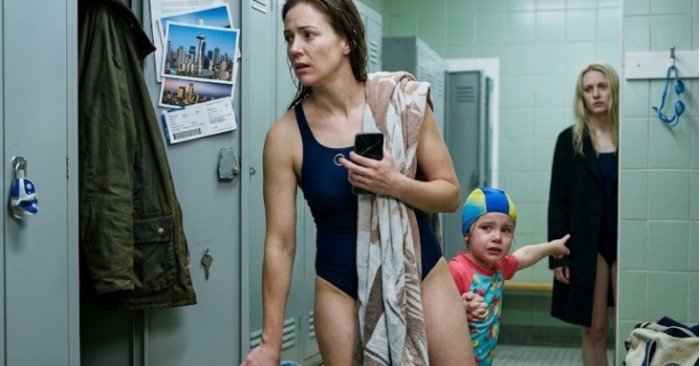
The woman reached for the locker door.
I blocked it with my arm.
“Don’t touch anything.”
My voice came out sharper than I expected.
Zoe pressed herself against my leg, still holding the little silver key.
The stranger looked from her to me.
Then toward the changing-room entrance.
“What is your name?” she asked.
“You first.”
She swallowed.
“Rachel.”
I lifted the wedding ring.
“My husband left home wearing this eleven days ago.”
Rachel stared at it.
Something inside her expression collapsed.
“He told me he lost it.”
The fluorescent lights buzzed above us.
Water dripped from Zoe’s hair onto my shoes.
Nothing else seemed real.
“Where is Michael?”
Rachel closed her eyes.
“So that is the name he gave you.”
My fingers tightened around the ring.
“Gave me?”
She sat slowly on the wooden bench, as though her knees had stopped supporting her.
“To me, he’s Jonathan.”
I laughed once.
Not because anything was funny.
Because my mind had rejected the sentence.
“My husband’s name is Michael Grant.”
Rachel looked at the second phone inside the locker.
“The man I know is Jonathan Hale.”
Zoe tugged my sleeve.
“Mommy, that’s Daddy’s secret phone.”
I looked down.
“How do you know?”
“He had it at the park.”
My heart lurched.
“What park?”
“The one with the red slide. He talked to that lady.”
Rachel covered her mouth.
“When?”
Zoe thought carefully.
“When you were helping Grandma.”
Three weeks earlier.
I had spent an afternoon taking my mother to a medical appointment.
Michael had offered to take Zoe to the playground.
Apparently, he had not gone alone.
I picked up the second phone.
The lock screen displayed a photograph of Michael smiling beside Rachel.
Between them stood a little boy of about seven.
The child had Michael’s eyes.
My throat closed.
“Who is he?”
Rachel looked at Zoe before answering.
“My son, Lucas.”
The room swayed.
I gripped the locker door.
“Is Michael his father?”
Rachel nodded.
“At least that is what I believed.”
Zoe looked up at me.
“Does Daddy have another family?”
I crouched immediately and held her shoulders.
“I don’t know yet, sweetheart.”
But I did.
At least part of it.
I turned to Rachel.
“How long?”
“Eight years.”
Michael and I had been married for nine.
The cruelty of the arithmetic felt almost deliberate.
Rachel stood and reached inside the locker.
I caught her wrist.
“What are you taking?”
“Proof.”
She slowly pulled out a blue document envelope.
Inside were identification cards.
Two passports.
One under the name Michael Grant.
One under the name Jonathan Hale.
The same photograph appeared on both.
Different birthdays.
Different signatures.
I stared at them until the letters blurred.
“This is not just an affair.”
Rachel shook her head.
“No.”
She removed another paper.
A marriage certificate.
Her name.
His false name.
Dated six years earlier.
My husband had not simply built another relationship.
He had married her.
“Why are these here?”
Rachel’s voice trembled.
“Because I found them yesterday.”
She explained that “Jonathan” had claimed he was traveling to Portland for work.
Just as Michael had supposedly gone to Seattle.
Rachel had become suspicious after discovering unfamiliar hotel key cards in his coat.
She followed him.
Not to an airport.
To a rented storage garage across town.
She watched him transfer clothes, documents, and several locked cases into his car.
Later, she found the locker key in his gym bag.
“This locker belongs to him,” she said. “He uses the pool because the membership is under another identity.”
“Then why were you locking it?”
“I came to take everything before he moved it again.”
She looked at the little silver key in Zoe’s hand.
“That opens the black case.”
There was a narrow hard-shell case at the back of the locker.
I had not noticed it beneath the jacket.
Zoe held the key toward me.
I did not want to open it.
But I had spent eleven days believing a skyline photograph was proof of a husband’s location.
I was finished believing appearances.
The key turned.
Inside the case were bundles of cash.
Several prepaid phones.
Property records.
And photographs of women.
Not only me.
Not only Rachel.
At least four others.
One photograph showed Michael beside a red-haired woman at a courthouse.
Another showed him holding an infant I had never seen.
A third showed him standing outside a house in another state.
Every photograph carried a date and a different name written on the back.
Rachel whispered, “Oh my God.”
Beneath them lay a folder filled with insurance policies.
Spousal policies.
Large ones.
My name appeared on one.
Rachel’s appeared on another.
Each listed a private company as beneficiary.
Not either of us.
I felt every protective instinct in my body rise at once.
I closed the case.
“We need the police.”
Rachel grabbed my arm.
“No. Not local police.”
“Why?”
She pulled out one final photograph.
Michael stood beside a man wearing a police captain’s uniform.
“My brother reported him missing once,” Rachel said. “That captain convinced him Jonathan was traveling and told him to stop harassing us.”
I knew the officer.
He had attended our daughter’s birthday party.
Michael called him Uncle Roy.
The changing-room door opened.
Both of us spun around.
A cleaner entered with a cart.
I nearly screamed.
Rachel exhaled.
“We cannot stay here.”
We gathered the documents and left the clothes exactly where they were.
At my car, I called the state investigative bureau from a number Rachel found through an official government directory.
Then I called my sister.
I told her to meet us somewhere public and not contact Michael.
While we waited, the second phone began ringing.
The name on the screen was not mine.
Not Rachel’s.
It said:
Home Three.
Neither of us answered.
A message appeared.
Locker compromised. Move the children.
Rachel made a sound like she had been struck.
“The children?”
I looked at Zoe.
Then at the photograph of Lucas on the phone.
This was no longer about betrayal.
Someone knew we had opened the locker.
And someone was watching our families.
State investigators arrived within forty minutes.
They separated us, photographed everything, and sent officers to retrieve Lucas from school.
My sister took Zoe.
I had to pry her fingers from my hand.
“Are you coming back?” she asked.
“Yes.”
I knelt until our faces were level.
“No matter what anyone tells you, I am coming back.”
She looked frightened.
“Is Daddy bad?”
I could not lie to her.
“Daddy has done things we do not understand yet.”
That was the kindest truth I could offer.
By evening, investigators knew more than I did.
Michael Grant was not his birth name.
Neither was Jonathan Hale.
His real name was Adrian Mercer.
He had been moving through multiple states for over fifteen years using relationships, marriages, false business ventures, and insurance policies to obtain money.
Some women had lost savings.
Some had signed homes into joint companies.
One had disappeared.
Her case had been classified as a voluntary departure.
The “trade conference” was a collection of staged photographs and automated messages.
He reused them every year.
The skyline image he sent me had been taken three summers earlier.
While I was arranging his boarding pass, he had already created a false digital check-in.
After I drove away from the airport, security cameras showed him exiting through another terminal door and entering a waiting car.
The driver was Captain Roy Ellis.
The man we called Uncle Roy.
The investigators moved quickly.
They searched the storage garage.
Then the house in the photograph.
They found Michael there with another woman, packing documents into suitcases.
He tried to run through the rear garden.
He did not get far.
Roy was arrested the same night for helping create false records, suppressing reports, and warning Michael when anyone became suspicious.
The missing woman was found alive two states away.
She had escaped years earlier but was too terrified to use her real identity.
Her testimony connected everything.
For weeks, I woke expecting Michael to walk into our bedroom and tell me it had all been a misunderstanding.
Grief does strange things.
Even when the person is alive, you mourn the version you loved.
Rachel and I spoke often.
At first, only because investigators needed us to compare dates.
Then because nobody else understood the humiliation of discovering an entire marriage had been arranged like a stage set.
Lucas met Zoe several months later.
They sat on opposite sides of a playground bench, staring at one another.
Finally, Zoe asked,
“Did he tell you he hated olives too?”
Lucas nodded.
“He said they tasted like rubber.”
Zoe sighed.
“He said the same thing at our house.”
They began laughing.
Not because it was funny.
Because children sometimes find the smallest door out of pain.
The trial lasted almost a year.
Michael never looked ashamed.
He looked inconvenienced.
When asked why he had created so many families, he said each woman had “wanted something from him.”
As though trust were a demand.
As though love were evidence against us.
The insurance documents became central to the case.
No one could prove he planned to harm us.
But the fraud, forged identities, theft, and conspiracy were enough.
He received a long prison sentence.
Roy lost his badge and his freedom.
The day after sentencing, I took Zoe back to the pool.
I expected the changing room to terrify me.
Instead, it looked ordinary.
Metal lockers.
Wet floors.
Children complaining about cold towels.
Zoe pointed toward the far corner.
“That’s where I found Daddy.”
I knelt beside her.
“No, sweetheart.”
“You found the truth.”
She thought about that.
Then she placed the little silver key in my palm.
Investigators had returned it after the case closed.
“Can we throw it away?”
I looked at the tiny object that had opened the case and shattered our lives.
“Yes.”
Together, we dropped it into a deep public trash bin outside.
It made almost no sound.
Years later, Zoe would remember very little about the passports or police interviews.
But she remembered that I listened to her.
That mattered most.
Adults often dismiss children because their words come out strangely.
A man cannot fit inside a locker.
But his secrets can.
And sometimes the smallest voice in the room is the first one brave enough to tell you where to look.